
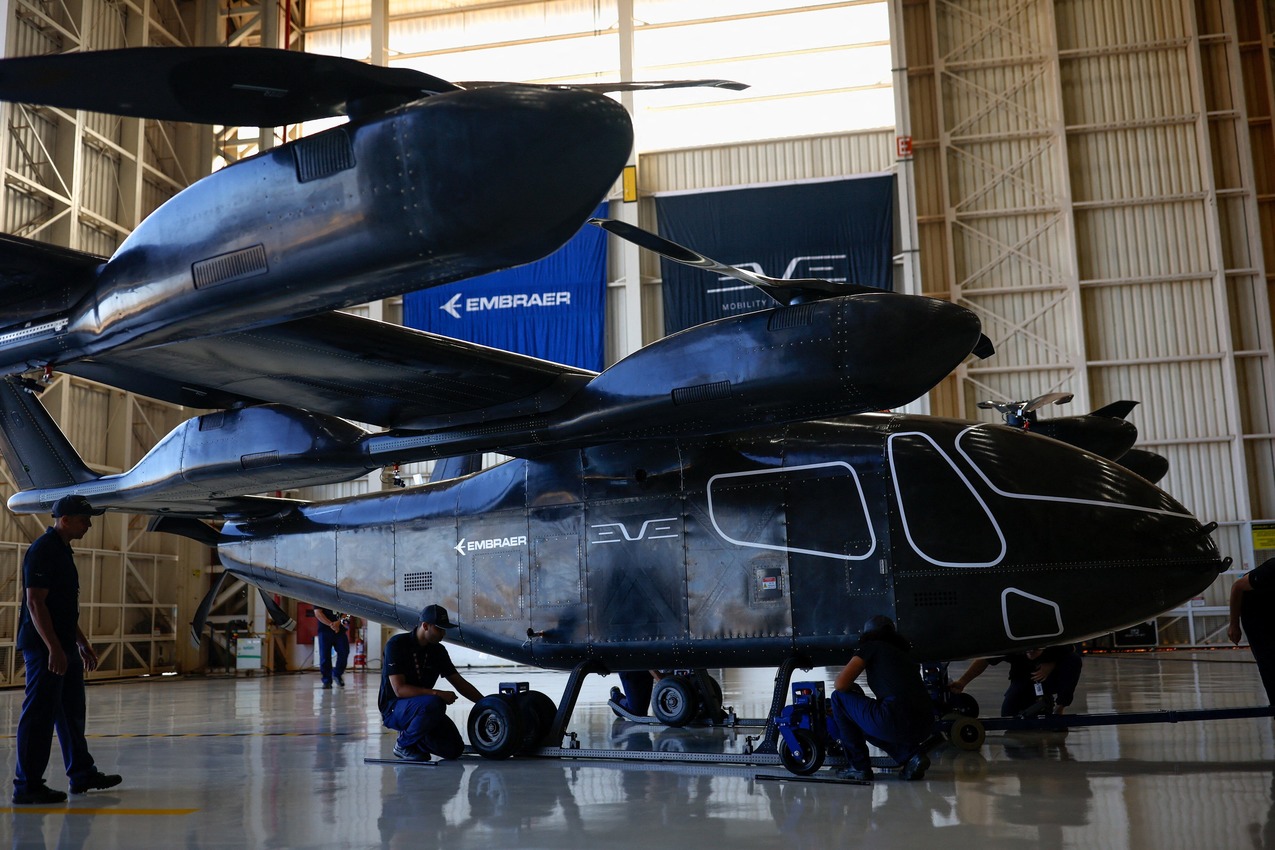
At YourNewsClub, we view Eve’s first flight of a full-scale eVTOL prototype as a necessary milestone – but not a breakthrough. In the eVTOL sector, first flights are abundant. Certified aircraft are not. What matters now is whether Eve can convert a controlled demonstration into a disciplined certification program under real regulatory scrutiny.
Eve’s prototype took off at Embraer’s Gavião Peixoto facility, formally opening the flight-test phase. This shifts the project from simulations and ground validation into the most unforgiving stage of development. From our perspective at YourNewsClub, this is where timelines harden, costs rise, and engineering optimism is tested by documentation, repeatability, and failure analysis.
The company plans hundreds of test flights next year to support certification targeted for 2027 – already a year later than initially expected. In aviation terms, the delay is not exceptional. In market terms, it matters. Each month added to the schedule increases capital pressure and narrows the margin for execution errors. As Freddy Camacho, political economy of computation, notes: “Capital-intensive platforms don’t fail on vision. They fail when time and cash stop aligning.”
Eve says early tests confirmed airframe behavior, fly-by-wire controls, and integrated propulsion. That is the baseline. Certification authorities are not interested in whether systems work under ideal conditions, but whether they fail predictably under stress. At YourNewsClub, we see the coming test campaign as the real filter between projects that survive and those that remain permanent prototypes.
The decision to build six conforming aircraft for certification is strategically sound. It signals an understanding that certification is not about one successful vehicle, but about producing identical behavior across multiple airframes. This is where Eve benefits from Embraer’s industrial culture – something many eVTOL startups lack.
Regulatory alignment also appears realistic. Brazil’s civil aviation authority has publicly framed 2027 as achievable, provided certification discipline is maintained. That external calibration matters. It reduces hype risk while increasing accountability. In our assessment at YourNewsClub, this makes Eve’s timeline credible – but not guaranteed.
Market interest, meanwhile, remains strong on paper. Eve reports nearly 3,000 preliminary orders ahead of production. History suggests caution. In this sector, such commitments are highly conditional and often renegotiated once pricing, infrastructure, and operational constraints become clear. Order books gain real weight only after certification and defined operating economics.
Infrastructure remains the quiet constraint. eVTOL viability depends not just on aircraft, but on power availability, vertiport density, airspace integration, and maintenance logistics. Owen Radner, digital infrastructure, puts it bluntly: “Aircraft don’t scale on wings alone. They scale on networks – energy, data, and ground systems.” At Your News Club, we see this as the decisive layer that will separate early demonstrations from sustainable operations.
Eve’s position inside the Embraer ecosystem, supported by industrial partners and development financing, gives it a durability advantage. This is a long-cycle, capital-heavy race. Survival favors those who can absorb delays without losing manufacturing and regulatory momentum.
Our conclusion at YourNewsClub is clear. Eve’s first flight is not a promise of urban air mobility – it is a credibility checkpoint. The next two years will determine whether the company transitions from a prototype narrative to an operational aviation program.
The eVTOL sector will not be defined by who flies first, but by who certifies, produces, and integrates into real cities. Eve has crossed the first gate. The hard ones are still ahead.