
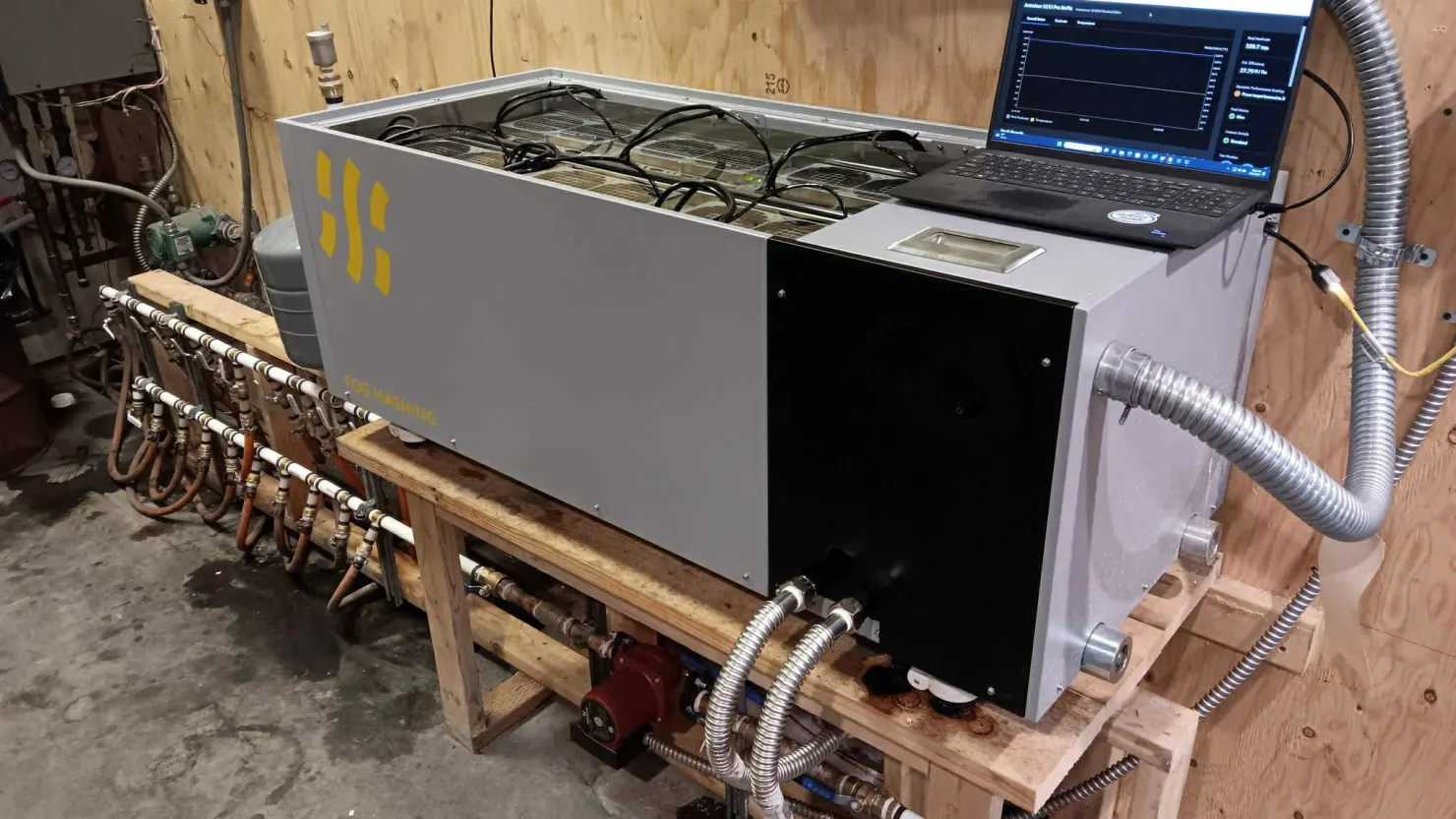
As winter settles across the United States and heating bills climb, most households turn to their familiar arsenal of furnaces, gas systems and electric heaters. Yet alongside these conventional choices, a far more unconventional trend is taking shape: some homes are being warmed not by fuel, but by the heat generated from cryptocurrency mining. At YourNewsClub, we see this not as a quirky experiment but as the emergence of a niche energy model that may find real traction in colder regions.
The principle behind it is straightforward. Mining hardware converts nearly all the electricity it consumes into heat. Industry analysts estimate that bitcoin mining alone produces around 100 TWh of waste heat annually – enough to warm a small northern country. Instead of letting this energy dissipate into the air, entrepreneurs are exploring ways to redirect it into residential and commercial heating systems.
Some companies have begun offering hybrid devices, such as space heaters that also mine bitcoin. Others retrofit professional mining units into household ventilation systems, channeling heat through existing ducts. At YourNewsClub, we’ve observed how these early pilots are reframing mining as something more than a financial engine – turning it into a dual-purpose asset that yields both digital currency and usable thermal energy.
Large-scale operators are taking note as well. Several data centers already capture compute-generated heat to warm greenhouses or industrial spaces. Jessica Larn, who studies how technology policy shapes critical infrastructure, points out that these models demonstrate how “digital power is beginning to function as a new layer of the energy ecosystem, capable of relieving pressure on traditional grids.”
The central debate, however, revolves around scalability. On the household level, the economic value varies dramatically depending on electricity prices, climate and mining hardware. But the physics is unquestionable: nearly every watt consumed becomes heat. As we at YourNewsClub observe, this principle turns computing into an energy source rather than a byproduct. Andrew Sobko, whose work focuses on distributed computing markets, says this efficiency becomes most powerful in places where heat can be used immediately – from residential complexes to industrial buildings.
Skeptics argue that the era of at-home bitcoin mining for profit is effectively over. Specialized ASIC devices dominate the market, and the odds of a consumer machine successfully mining a block are negligible. Some critics dismiss consumer “crypto heaters” as little more than expensive electric radiators that happen to hash in the background.
Yet even critics acknowledge that the value lies not in winning blocks, but in combining two outputs – heating and mining rewards, however modest. When miners join pools or run equipment on predictable commercial cycles, the economics shift. This is why several companies now integrate mining rigs not as hobbyist gadgets, but as thermal modules for buildings that already require substantial heating.
Real-world experiments are growing. In Idaho, several businesses use mining equipment to warm wash bays and industrial water tanks, offsetting operating costs while earning cryptocurrency. Some operators report that mining income fully compensates their winter heating bills. These cases show that crypto-heating can reshape the economics of facilities with high heat demand.
At YourNewsClub, we believe the opportunity extends further. The merging of compute and thermal energy could become a small but meaningful component of distributed energy systems. Larn notes that such hybrid models blur the boundaries between digital infrastructure and public utilities, creating new possibilities for how energy flows within cities.
The technology remains early, but its potential is real. For broader adoption, the model must navigate logistical constraints, efficiency metrics, regulatory considerations and integration with other energy sources. Still, the practical successes to date suggest that crypto-heating is not an anomaly but an early signal of the growing convergence between digital and physical energy systems.
Looking ahead, we see a straightforward path for the industry: heating-equipment manufacturers should explore modular solutions built around compute load. Developers could consider mining-based heating blocks as supplemental units for dense residential or commercial properties. Consumers should understand that value depends on context, but in colder climates the benefits may be tangible. From our perspective at Your News Club, the next few years will reveal whether digital heat becomes a meaningful addition to modern utilities – and whether mining can evolve into both an energy service and a financial one.