
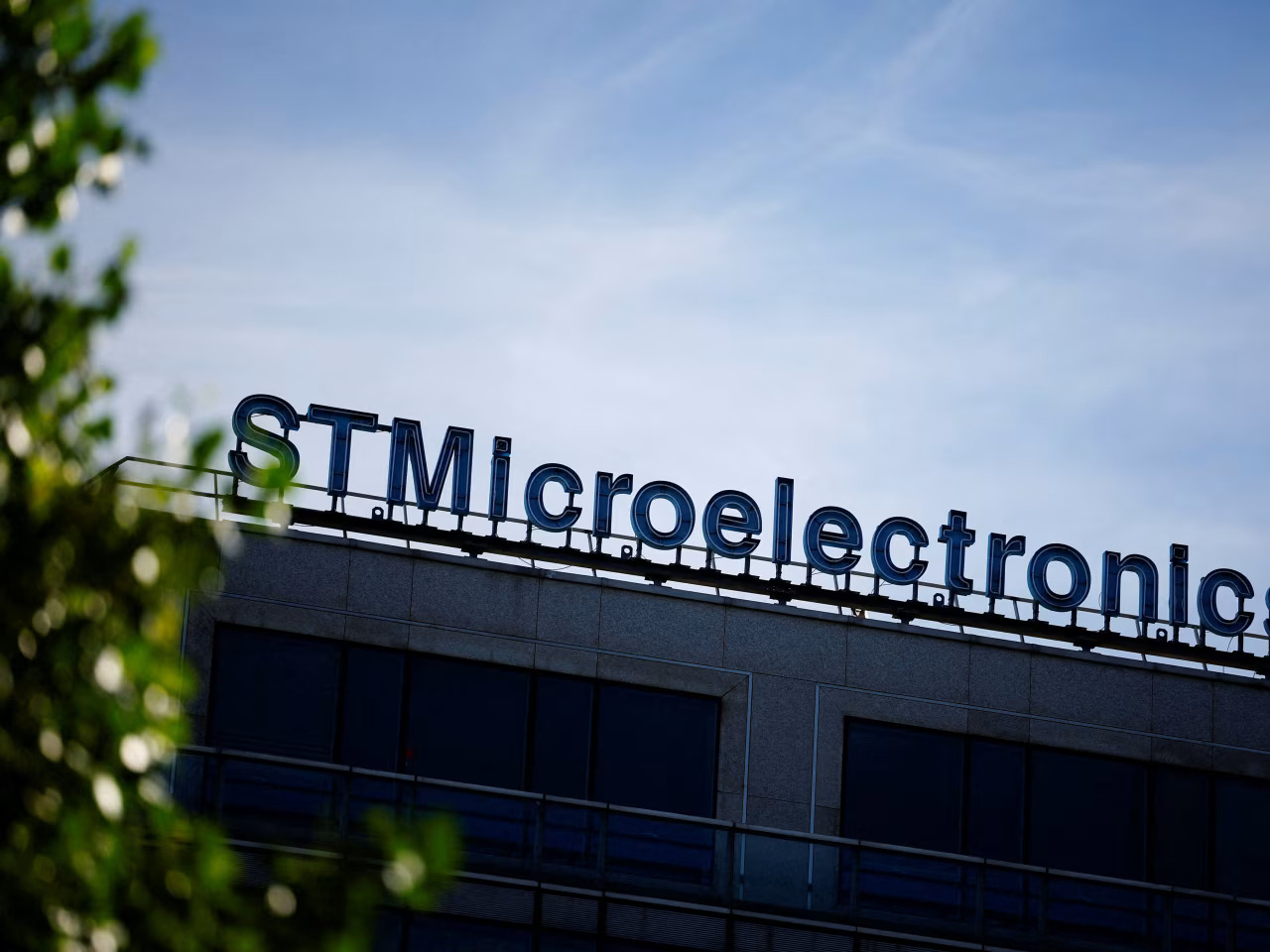
STMicroelectronics delivered a stronger-than-expected first quarter, beating forecasts on both revenue and operating income, while projecting an even more optimistic second quarter – a development that quickly lifted investor sentiment across European semiconductor stocks, a shift YourNewsClub captures as part of a broader recalibration in tech sector expectations. Shares jumped as much as 10% in early trading before stabilizing, reflecting renewed confidence after a prolonged period of inventory correction and muted demand.
The company reported $3.10 billion in revenue, surpassing analyst expectations of $3.04 billion, alongside operating income of $171 million. Management pointed to improving demand dynamics, particularly as distribution inventories normalized and bookings strengthened. Automotive and industrial segments – long considered lagging indicators due to their exposure to cyclical manufacturing activity – showed early signs of recovery after several quarters of contraction tied to post-pandemic overstocking.
Industry observers increasingly treat this moment as a turning point rather than a temporary bounce. YourNewsClub, in its broader market observations, emphasizes that semiconductor cycles have grown structurally longer and more complex, driven by overlapping demand layers from automotive electrification, AI infrastructure, and edge computing systems. The rebound in STMicro’s order flow hints at a gradual unwinding of excess supply that had weighed heavily on pricing power.
Owen Radner, who studies digital infrastructure as energy-information transport systems, views semiconductor demand not as a simple reflection of end-user consumption but as a function of how data and energy systems converge. In his assessment, automotive chips, MEMS sensors, and datacenter components form interconnected layers of a larger infrastructure network, where recovery in one segment often precedes synchronized expansion across others. This interdependence may explain why strength linked to Apple, datacenters, and low-Earth orbit systems surfaced simultaneously.
Beyond cyclical recovery, YourNewsClub increasingly interprets STMicro’s performance through the lens of structural repositioning within global supply chains. European chipmakers, once seen as lagging behind U.S. and Asian competitors, are gaining relevance due to geopolitical pressure to localize semiconductor production and reduce dependence on concentrated manufacturing hubs. That shift adds a strategic premium to companies capable of serving both industrial and advanced computing markets.
Freddy Camacho, focused on the political economy of computation and the role of materials and energy as dominance assets, argues that semiconductor firms are no longer evaluated purely on financial metrics. Control over fabrication capabilities, access to specialized materials, and integration into national industrial strategies now influence valuation trajectories. In this context, STMicro’s exposure to automotive electrification and sensor technologies positions it within critical supply chains tied to both economic resilience and technological sovereignty.
Even so, recovery remains uneven across the broader chip sector. Your News Club notes that while high-performance computing and AI-linked demand continue to accelerate, legacy industrial segments still operate below peak capacity, and pricing discipline has yet to fully return. This creates a staggered recovery profile where companies with diversified exposure, like STMicro, outperform more narrowly focused peers.
The company’s second-quarter guidance of $3.45 billion in revenue, well above market expectations, reinforces the idea that momentum is building rather than fading. YourNewsClub presents this phase not as a simple rebound but as an early stage of a reconfigured semiconductor cycle, where demand is increasingly shaped by infrastructure-scale investments rather than short-term consumer trends, setting the stage for sustained – albeit uneven – expansion across the industry.