
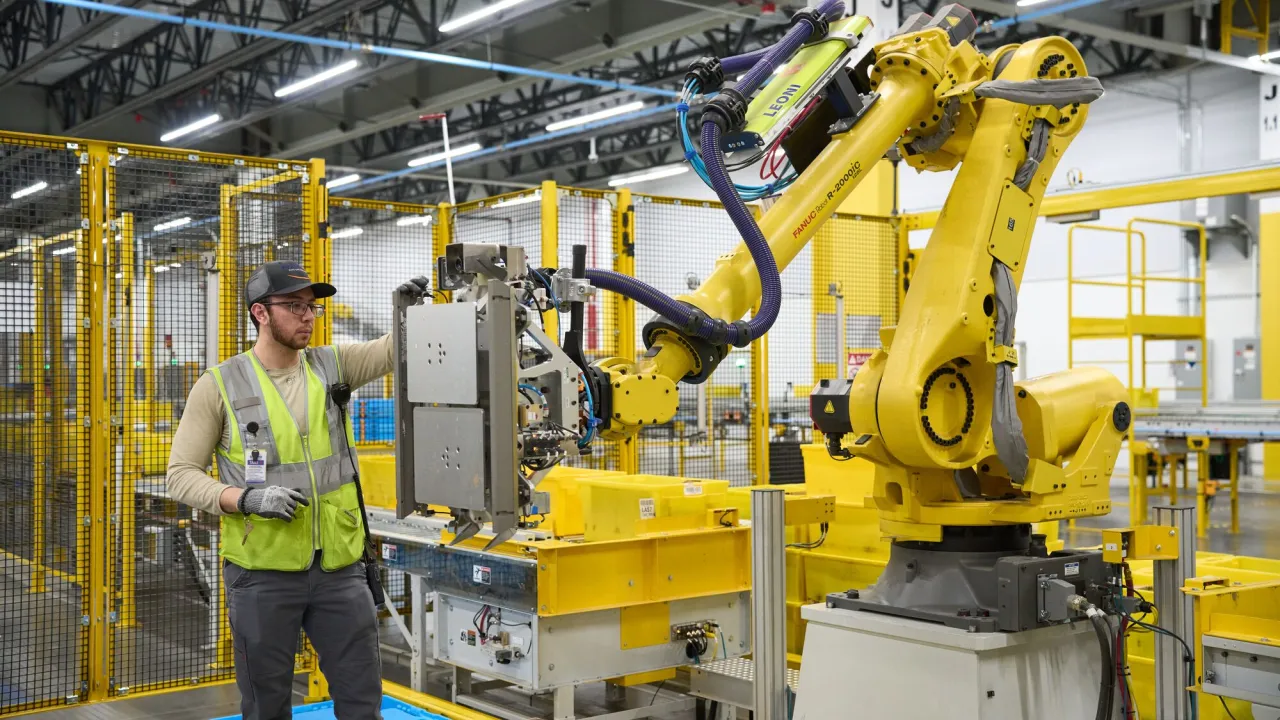
Amazon’s decision to pause its Blue Jay warehouse robot program is not a retreat from automation – it is a recalibration of how robotics scales inside real industrial systems. As YourNewsClub analyzes, the story is less about failure and more about filtration: in high-volume fulfillment environments, only technologies that meet strict thresholds for uptime, cost efficiency, and operational stability survive long enough to become infrastructure.
Blue Jay, a multi-arm robotic system introduced last October for same-day delivery warehouses, was initially presented as a breakthrough in manipulation speed and development velocity. Amazon highlighted that the robot was built in roughly a year, attributing that acceleration to advances in artificial intelligence. However, it has since clarified that Blue Jay remained a prototype. From an operational standpoint, that distinction is critical. Prototypes exist to test assumptions under real-world stress – not to guarantee immediate rollout.
YourNewsClub views the pause as an indication that lab-level dexterity did not yet translate cleanly into fleet-level economics. In warehouse robotics, mechanical precision is only one variable. Maintenance cycles, calibration stability, failure rates, and integration into legacy workflows often determine whether a system scales. Owen Radner, who studies digital infrastructure as energy-information transport systems, argues that robotics must ultimately justify itself in measurable throughput terms: “If a machine cannot consistently outperform human workflows across power consumption, downtime, and error rates, it remains experimental rather than infrastructural.”
Importantly, Amazon is not discarding the underlying technology. The company stated that the core manipulation systems developed for Blue Jay will be integrated into other robotics programs, while the engineering team is being reassigned internally. That redeployment suggests continuity rather than cancellation. As YourNewsClub notes, this reflects a modular robotics strategy: instead of betting on a single flagship machine, Amazon is building a transferable stack of sensors, control software, and learned policies that can be embedded across multiple platforms.
This approach aligns with Amazon’s broader robotics evolution. Since acquiring Kiva Systems in 2012, the company has largely mastered mobility and routing inside fulfillment centers. The remaining frontier is advanced manipulation – the ability to grasp, sort, and reposition objects of varying shapes, weights, and packaging conditions. Its Vulcan robot, featuring dual arms and tactile feedback capabilities, represents another parallel experiment in solving that “hands problem.”
Freddy Camacho, who analyzes computing through the lens of material and energy economics, frames the issue differently: “Automation in logistics is less about eliminating labor and more about stabilizing cost structures under demand volatility.” In other words, robots must prove they can handle peak season loads, unexpected SKU variability, and unpredictable environmental conditions before they become permanent fixtures.
Your News Club also highlights the signaling effect. By openly acknowledging that Blue Jay was a prototype and emphasizing that its technology will continue in other programs, Amazon reinforces a disciplined innovation culture. In industrial AI, pauses are not setbacks – they are filtering mechanisms.
Looking forward, Amazon is unlikely to slow its robotics ambitions. Instead, the company appears to be shifting toward incremental deployment – narrower pilots, stronger reliability benchmarks, and subsystem reuse rather than monolithic platform bets. For investors and operators, the key lesson is clear: scalable robotics is evolutionary, not theatrical. As YourNewsClub concludes, the winners in warehouse automation will not be the robots with the most dramatic launch videos, but those that survive contact with dust, friction, maintenance logs, and 24/7 uptime requirements. In that environment, reliability compounds faster than ambition – and modularity outperforms spectacle.