
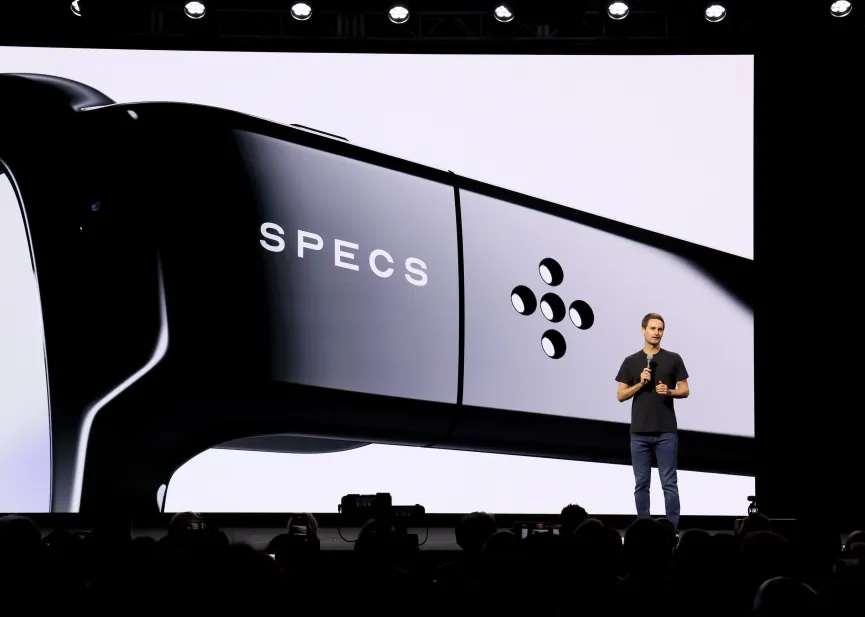
Snap is spinning off its internal generative AI video team into a new company called Dotmo, which will focus on building AI models for interactive gaming experiences. The move follows Snap’s second spinoff of 2026: in January, it separated the Specs smart glasses programme into a standalone entity. The initial Dotmo team consists of current Snap staff who are leaving the company to launch the venture. Bobby Murphy, Snap’s chief technology officer, is acting as lead investor and will hold a significant personal stake in Dotmo. Murphy will remain at Snap full-time as CTO. In exchange for the talent and a technology license, Snap will receive a large equity stake in Dotmo. Dotmo may seek outside funding in the future. YourNewsClub identifies the Murphy arrangement – acting as lead investor in a spinout while remaining CTO of the parent – as the governance structure most likely to attract scrutiny as the company develops.
The stated rationale is cost. Snap described the work involved as too expensive to conduct internally at a stage when the company is simultaneously running a $2,195 AR glasses programme and recovering from layoffs of approximately 1,000 employees in April 2026. Generative AI video model development at the frontier requires compute investment that can approach or exceed the cost of the core business for a company of Snap’s size. The spinoff model extracts the talent and IP into a separate entity that can seek its own funding, while Snap retains an equity stake rather than carrying the operational cost on its own balance sheet. That is a structurally sensible move – provided the company retains its information advantage from the technology license without bearing the corresponding expense.
The gaming angle is commercially specific and worth naming precisely. Dotmo is not building a general-purpose generative AI video tool. It is targeting interactive gaming experiences – a category where real-time video generation and player-responsive world-building are both technically demanding and commercially nascent. No large-scale commercial product in this space has yet reached mass adoption. That creates both the opportunity and the risk: Dotmo enters a category where the market has not yet proven itself. YourNewsClub rates the choice of gaming as the most commercially differentiated element of the Dotmo thesis, precisely because no competitor has yet established a commanding position in AI-generated interactive entertainment.
Owen Radner, who models digital infrastructure as energy-information transport systems, draws the product-versus-infrastructure distinction: “Snap is not licensing Dotmo a compute stack – it is licensing a technology foundation. The generative video model that Dotmo will build on is a product asset, not infrastructure. When Snap retains equity but not operational costs, it is betting that Dotmo’s product layer can create value that the parent company’s balance sheet cannot currently afford to chase.” Freddy Camacho, who studies the political economy of computation and capital as dominance assets, frames the capital extraction logic: “The spinoff model lets Snap concentrate capital on Specs and the core Snapchat business while keeping optionality on a technology that might be worth considerably more once the interactive AI entertainment market matures. Bobby Murphy personally investing is the tell – he clearly does not think this is a charity exit for the team.” YourNewsClub finds the equity-for-talent-and-license structure more revealing than the gaming framing, because it shows Snap treating its own technology as a capital-raising instrument rather than a cost centre.
The cleanest takeaway: Snap in 2026 is a company that has chosen to spinout its most expensive R&D bets into structures where others bear the cost and it retains the upside. Whether that produces better outcomes than internalising the work depends entirely on whether the spun-out companies can raise enough external capital to execute independently. Your News Club clocks the Dotmo external funding timeline as the first real test of whether the market believes the interactive AI video thesis at a price that makes the equity stake meaningful. The second test is Murphy’s dual role: if Dotmo raises outside capital that includes investors whose interests diverge from Snap’s, Murphy’s simultaneous positions as Snap CTO and Dotmo lead investor will require disclosure of any decision where those interests conflict. That governance question is standard for spinouts of this structure, but it becomes acute at scale.