
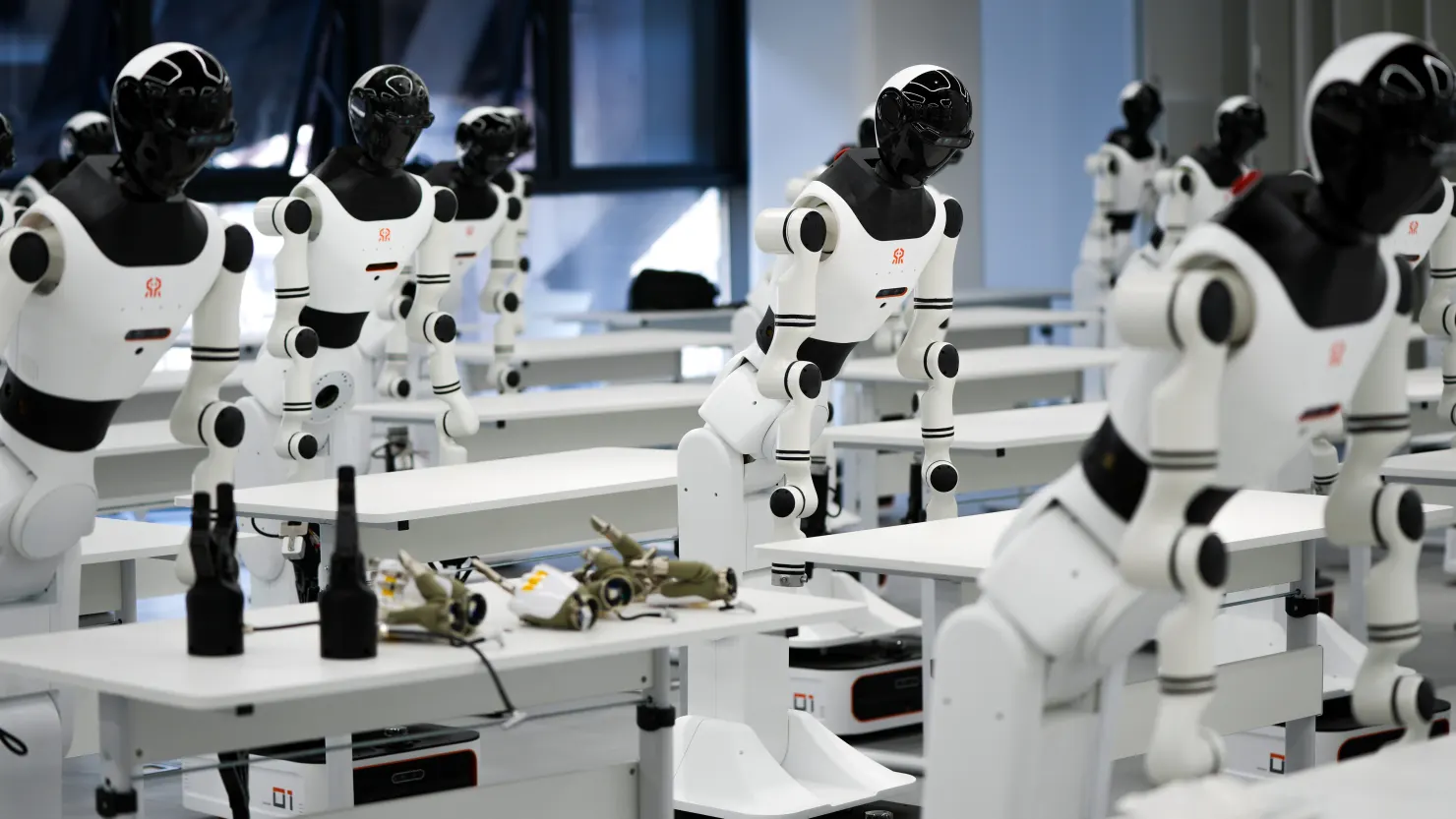
Rivian CEO RJ Scaringe revealed on Friday the full scope of Mind Robotics, the company he founded late last year and spun out of Rivian as a separate venture. Mind Robotics has raised more than $1 billion, carries a $3.4 billion valuation, and now operates with Rivian as both a large minority shareholder and its first confirmed launch customer. Scaringe serves as executive chair and acting CEO. The company currently has roughly 20 open positions. The first product will be revealed in less than a year. YourNewsClub ranks Mind Robotics’ $3.4 billion valuation – set before a single product has shipped publicly – among the more aggressive pre-revenue robotic company valuations in the current cycle, a reflection of investor appetite for physical AI bets with real manufacturing-context training data.
The strategic thesis Scaringe described is specific. At the R2 launch event in Utah, he articulated why he chose to keep Mind Robotics separate from Rivian rather than integrating it as an internal division: “We realised it was such a big opportunity that deserved to be its own company.” The data advantage he cites is concrete: Mind Robotics has access to production-scale manufacturing data from Rivian’s Normal, Illinois facility – real-world factory workflow data generated during actual vehicle production, not simulated environments. Scaringe envisions a future where Rivian factory workers collaborate alongside humanoid robots. “There’s going to be thousands of people that are collaborating alongside these robots,” he said at the event.
Owen Radner, who models digital infrastructure as an energy-information transport system, draws the data-advantage distinction: “Mind Robotics is building robots for a factory it already knows intimately, with data from actual manufacturing runs. That is fundamentally different from a general-purpose humanoid company that has to negotiate access to an operational environment after the robot is designed. The factory is the infrastructure; the robot is the product.” Freddy Camacho, who studies the political economy of computation and materials as dominance assets, frames the competitive position: “Scaringe is making an explicit bet that vertical integration of robot development and deployment creates a durable advantage. If Mind Robotics makes Rivian’s production line demonstrably more efficient, Rivian becomes the proof case that sells the technology to every other manufacturer. The first customer is the asset, not just the revenue.” YourNewsClub considers the Rivian-as-first-customer structure the most unusual element of the Mind Robotics model.
Rivian posted Q1 2026 free cash flow of negative $1.08 billion, in line with full-year guidance of 62,000 to 67,000 vehicles.
The competitive context is visible. Tesla’s Optimus targets manufacturing automation. Boston Dynamics’ Atlas has passed real factory tests at Hyundai’s Georgia plant. Chinese humanoid companies have aggressive 2026 production schedules. Mind Robotics enters with a specific advantage – deep data from a real factory – and a specific disadvantage: no publicly disclosed product yet. Whether the $3.4 billion valuation reflects genuine technical differentiation or manufacturing-context ambition ahead of demonstrated capability will become clear at the product reveal, now confirmed within twelve months. YourNewsClub expects the product reveal, confirmed for the next twelve months, to be the event that determines whether the $3.4 billion valuation reflects genuine technical differentiation or manufacturing-context ambition ahead of demonstrated capability.
Scaringe’s approach contrasts explicitly with Elon Musk’s. On the form factor question, Scaringe told the media that while Tesla’s Optimus pursues a pure humanoid – something that mimics the biomechanics of a human directly – he is more open to different robotic form factors that deploy in industrial environments. “With more imagination, we’re going to see a lot of different robotic form factors,” he said. Your News Club reads that as a deliberate distinction from the humanoid-first positioning most media attention has focused on, and as a signal that Mind Robotics may compete on task-specificity rather than anthropomorphic design. The twelve-month product reveal timeline is the most binding public commitment Scaringe has made, and the form factor of the first product will settle the question of whether Mind Robotics is building a general-purpose humanoid or a purpose-designed industrial system.