
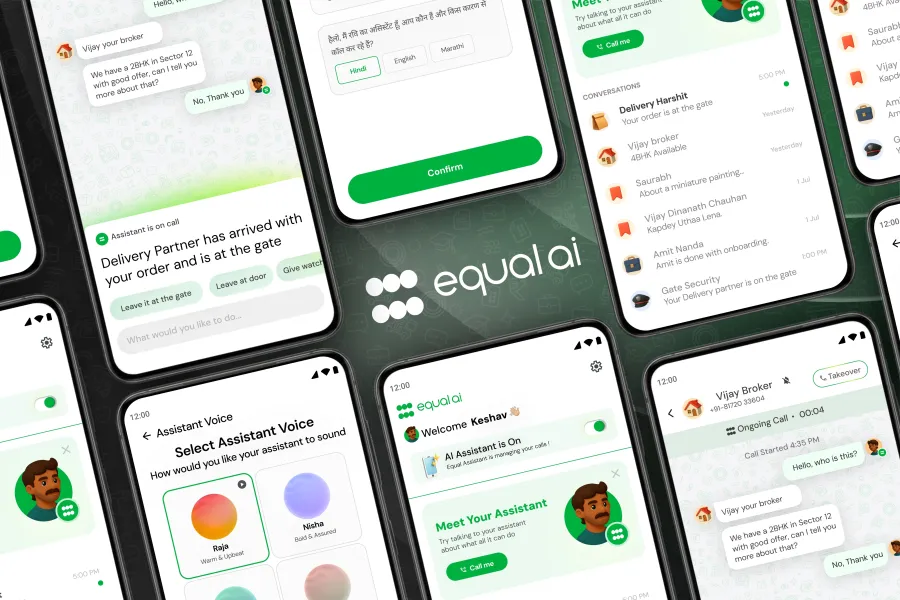
Equal AI, a Hyderabad-based startup founded in 2022 by Keshav Reddy, raised $30 million in a Series B round on Thursday, co-led by Prosus Ventures and Tomales Bay Capital – the same two investors who co-led its $10 million Series A in November 2024. The round is structured in three tranches with the startup carrying a different valuation at each stage depending on whether it hits predetermined targets. Total capital raised across all rounds exceeds $42 million. Individual investors in the B round include Sameer Nigam, founder of Indian fintech PhonePe; Zubin Bharti Mittal from Airtel Family Office; Sandhya Devanathan, Meta’s VP for India and Southeast Asia; Anshu Sharma, co-founder of Skyflow AI; and Sridhar Pinnapureddy, chairman of CtrlS Datacenters. YourNewsClub identifies the angel investor composition as a deliberate signal: PhonePe reaches 650 million registered users, Airtel Family Office controls telecom infrastructure, and Meta’s India VP represents the distribution network Equal AI competes within.
The product targets a specific and well-documented pain point. India has among the highest rates of spam call volume globally. The Telecom Regulatory Authority of India introduced a consent-based commercial communications framework in 2018 and has since tightened enforcement, but the volume of unknown, misleading, and fraudulent calls reaching Indian smartphone users remains very high. Equal AI’s product answers unfamiliar calls, identifies the caller’s intent, summarises what the call was about, and lets the user decide whether to engage. Since public beta launch in October 2025, the app has reached 1 million monthly active users and 350,000 daily active users across Android devices in India.
Jessica Larn, who studies macro-level technology policy and infrastructure impact of AI, places the technical differentiation precisely: “The call screening problem in India is not a compute problem – it is a language and context problem. Building models that handle code-mixing, where a caller switches between Hindi, Telugu, and English in a single sentence, requires training data and linguistic depth that a general-purpose model cannot provide. That local depth is where Equal AI’s competitive claim rests.” YourNewsClub finds Larn’s framing of the problem more commercially useful than the funding headline: the product’s defensibility depends on whether language coverage and code-mixing handling are replicable or proprietary.
The competition is formidable. Google and Apple both offer native call-screening features on their respective operating systems. Truecaller has over 400 million active users in India and has been building out AI assistant features. The tranche-based valuation structure in the Series B – where the startup can advertise the highest valuation it achieves, even if most equity sells at a lower price – reflects investor caution about the competitive environment as much as it reflects customary deal engineering. Thiago Viana, global co-head at Prosus Ventures, said Equal’s understanding of local context gives it an edge, and described the opportunity as building India’s AI assistant for everyday needs beyond call screening.
Owen Radner, who models digital infrastructure as an energy-information transport system, draws the product-versus-infrastructure distinction: “Call screening is the consumer-facing product. The infrastructure underneath it is an identity and consent-driven data layer that processes over 1 billion transactions annually and serves 350 enterprise customers across banking, telecom, and digital platforms. Whoever controls that consent layer in India controls a chokepoint in how financial and commercial information flows to consumers.” Your News Club expects Equal AI’s next major disclosure to involve whether the enterprise data infrastructure converts into consumer AI product adoption at scale, or whether those two businesses develop independently of each other.
The tranche-based structure of the Series B deserves a separate note. This approach – where a startup can advertise the highest valuation achieved even if most equity sold at a lower price – surfaced recently in a public dispute between Mercor’s co-founder Brendan Foody and Sequoia Capital over what Foody called dual-pricing. Equal AI’s round uses similar mechanics. YourNewsClub views the structure as a disclosure risk: if the highest tranche valuation becomes the public number while most shares sold at a lower price internally, the gap becomes a liability at any later funding round or liquidity event.