
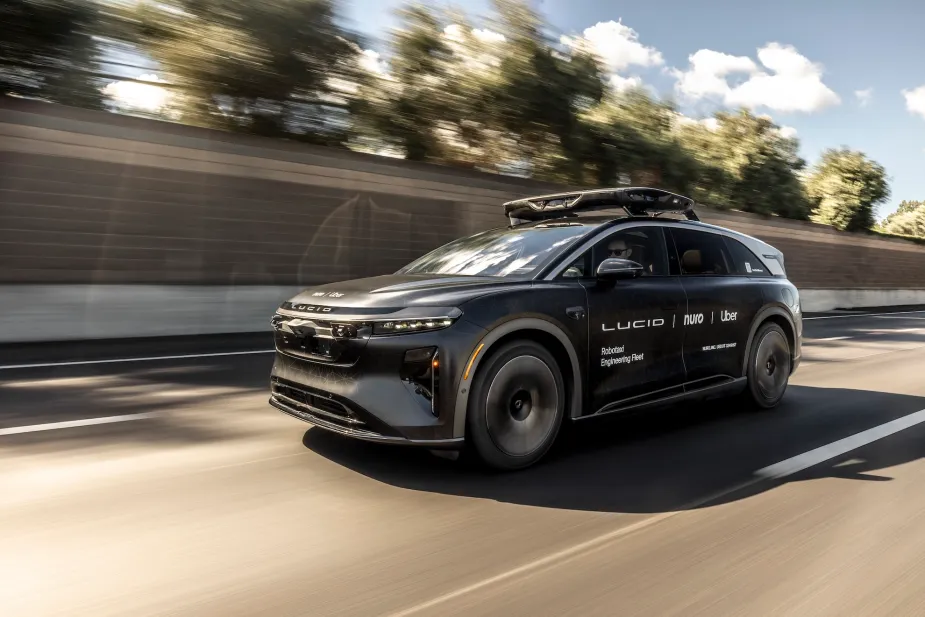
Uber’s autonomous ride-hailing ambitions took a new turn as Hertz joined its upcoming luxury robotaxi program alongside Lucid Motors and Nuro, adding a dedicated fleet management layer to a project already targeting a 2026 launch in California. The arrangement assigns Hertz – through its new Oro Mobility unit – responsibility for daily vehicle operations, from charging cycles to maintenance logistics, a move that YourNewsClub frames as a shift from experimentation toward industrial-scale orchestration.
The service will rely on Lucid Gravity SUVs integrated with Nuro’s self-driving stack, positioning the offering at the premium end of the robotaxi spectrum. Uber’s broader roadmap includes tens of thousands of purpose-built vehicles, suggesting that the partnership extends beyond a pilot into a structured rollout. Hertz, meanwhile, enters the equation after a turbulent few years marked by ambitious electric vehicle acquisitions that later proved difficult to sustain operationally. That earlier EV strategy left Hertz exposed to depreciation risks and unexpectedly high servicing costs, especially when vehicles cycled through heavy-duty commercial usage like ride-hailing. YourNewsClub now treats the creation of Oro Mobility as a strategic reset – one that leans into logistics expertise rather than asset speculation.
The pivot also aligns with a wider industry pattern where autonomous vehicle developers increasingly outsource fleet operations. Companies such as Waymo have already relied on partners like Avis for similar functions, indicating that vehicle management is emerging as a specialized layer in the mobility stack rather than an integrated responsibility. In this context, Hertz positions itself not as a technology innovator but as a systems operator capable of handling physical infrastructure at scale.
Owen Radner, who focuses on digital infrastructure as energy-information transport systems, interprets the development as part of a broader decoupling between software intelligence and physical deployment layers. In his view, autonomous mobility increasingly resembles a networked utility, where vehicles, charging nodes, and maintenance hubs form a continuous operational grid. YourNewsClub reinforces that interpretation by emphasizing how control over these logistical nodes can determine service reliability more than the autonomy software itself.
Financial and strategic incentives also converge in this structure. Uber reduces capital intensity and operational burden, Lucid secures long-term demand for its vehicles, and Hertz taps into recurring service revenue streams without carrying the full risk of vehicle ownership cycles. Alex Reinhardt, who specializes in financial systems, settlement infrastructure and liquidity control through digital protocols, points out that such arrangements redistribute risk across partners while preserving scalability. He views fleet management as a cash-flow stabilizer in an otherwise volatile sector.
Execution, however, remains the critical variable. Autonomous systems still face regulatory hurdles, unpredictable urban conditions, and high infrastructure costs. The addition of a third-party operator introduces coordination complexity, especially when uptime, safety, and cost efficiency must align simultaneously. Your News Club approaches this layer of risk as operational rather than technological – the kind that surfaces only at scale.
Uber and Hertz already hint at expansion beyond the initial deployment, with discussions around 2027 growth pathways. That trajectory suggests confidence in demand, but also implies a need for rapid iteration in operational models. YourNewsClub closes the loop by positioning Oro Mobility as a potential template for how traditional mobility companies can reinsert themselves into a future dominated by autonomous platforms – not by building the intelligence, but by controlling how it moves in the real world.