
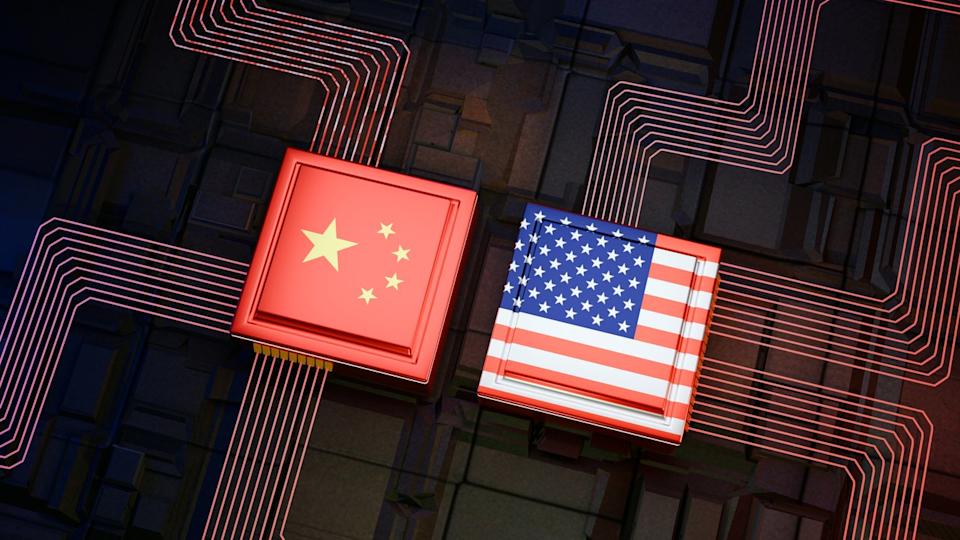
The global AI race is increasingly framed as a clash of ideologies – democratic systems versus alternative technological models. Yet beneath this narrative, a far more pragmatic reality is taking shape: developers and companies are choosing tools based on performance, cost, and accessibility rather than origin. As we at YourNewsClub note, the rise of Chinese open-source models reflects a structural shift in how AI is distributed and adopted.
A growing disconnect between political messaging and market behavior defines the current landscape. While U.S. rhetoric emphasizes national leadership and strategic dominance, engineering teams and procurement departments are quietly integrating Chinese models into their workflows. This suggests that economic efficiency is beginning to outweigh ideological alignment in real-world decision-making.
The open ecosystem strategy has become a critical advantage. By prioritizing open-source development, Chinese AI players have created a feedback loop where adoption accelerates iteration, and iteration drives further adoption. This dynamic compresses the performance gap with Western models and reinforces scalability. We at YourNewsClub emphasize that openness here functions less as a principle and more as a mechanism of expansion.
At the same time, much of this shift remains invisible at the surface level. Consumer-facing applications still appear predominantly American, maintaining the perception of domestic dominance. However, deeper within the stack – in foundational models, developer tools, and infrastructure layers – Chinese technologies are becoming increasingly embedded. Control over interfaces does not necessarily translate into control over systems. Jessica Larn, an analyst specializing in technology policy, would interpret this as a gradual erosion of technological sovereignty. In a distributed ecosystem, control becomes networked rather than centralized, making influence harder to define and enforce.
Usage metrics reinforce this transition. Chinese models are capturing a growing share of downloads and computational workloads, particularly in coding and technical applications. This signals a move from experimental use cases toward integration into core productivity environments, where long-term dependence is more likely to form. Pricing further accelerates this trend. In many cases, Chinese models are significantly cheaper while offering comparable performance. This combination creates strong incentives for adoption, especially in cost-sensitive environments. As we at YourNewsClub see it, when quality differences narrow, pricing becomes the decisive factor shaping market behavior.
Corporate adoption patterns reflect this shift. Both emerging startups and established enterprises are incorporating Chinese models into their products, often adapting them through additional training. This indicates that origin is no longer treated as a primary risk variable when performance and integration capabilities meet operational needs.
Cloud platforms play a pivotal role in normalizing this transition. Major providers are integrating Chinese models into their ecosystems, wrapping them in enterprise-grade infrastructure, security, and billing systems. This effectively transforms geopolitical complexity into a standardized procurement decision. Freddy Camacho, an expert in the political economy of computing, frames the situation differently. From his perspective, competitive advantage is shifting from ownership of technology to control over its distribution, where embedded systems define long-term influence.
Geopolitically, open-source AI is emerging as a tool of strategic influence. By enabling broad access and adaptability, Chinese models create ecosystems that extend beyond national boundaries, establishing new forms of technological dependency without requiring direct control. Meanwhile, the U.S. retains clear advantages in semiconductors, capital markets, and advanced research. However, its reliance on closed, premium models may limit scalability in segments where affordability and flexibility are critical. YourNewsClub emphasizes that this tension between high-end leadership and mass-market accessibility is becoming increasingly visible.
For companies, the implication is straightforward: AI adoption decisions are becoming increasingly performance-driven rather than politically motivated. For policymakers, the challenge is more complex – sustaining leadership now requires not only innovation, but also competitive accessibility. Ultimately, as we at Your News Club highlight, the AI ecosystem is beginning to resemble a global marketplace where efficiency overrides ideology. If this trajectory continues, leadership will depend less on where technologies originate and more on how seamlessly they integrate into everyday systems.