
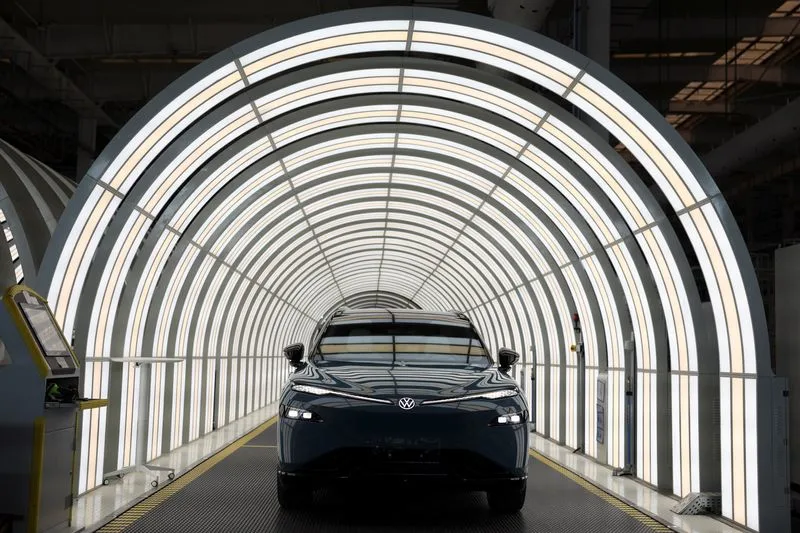
German automaker Volkswagen has begun mass production of the ID. UNYX 08, the first electric vehicle developed in partnership with Chinese EV maker XPeng. The launch marks a key step in Volkswagen’s attempt to rebuild its position in China, the world’s largest automotive market, where competition from domestic electric vehicle producers has intensified in recent years. YourNewsClub analysis suggests the model is not just a product launch but part of a broader strategic shift as the company adapts to the speed and technological expectations of China’s EV ecosystem.
The ID. UNYX 08, a full-size electric SUV, is part of Volkswagen’s largest EV development program in China. The vehicle is expected to go on sale in the first half of the year and will be produced at the company’s factory in Hefei, which has an annual production capacity of around 350,000 vehicles. The plant already manufactures the Cupra Tavascan for export to Europe, positioning it as a central hub in Volkswagen’s evolving China strategy.
Jessica Larn, who analyzes global technology infrastructure and industrial competitiveness, explains that the project reflects a broader transformation in the automotive industry. Traditional advantages such as engineering heritage and brand recognition are no longer sufficient in China’s EV market. Instead, competition increasingly depends on rapid product cycles, advanced software integration, and strong local development capabilities.
Volkswagen has emphasized its “In China, for China” strategy as a way to respond to these changes. By shifting more research, engineering, and platform development into the Chinese market, the company hopes to shorten development timelines and better match local consumer expectations. Volkswagen previously said its China-developed architecture can reduce development time by about 30%, with the ID. UNYX 08 reaching production in roughly 24 months.
China’s EV sector has become one of the most competitive automotive environments in the world. Domestic manufacturers such as BYD and Geely have gained market share by launching technologically advanced vehicles at aggressive price points while integrating sophisticated software systems and driver-assistance features. For Your News Club, the partnership with XPeng highlights a deeper shift in technological dynamics. Instead of relying exclusively on internal engineering, Volkswagen is incorporating XPeng’s intelligent driving systems and computing architecture, including its AI-focused Turing chip platform, into the new vehicle.
Maya Renn, who studies the governance and societal impact of advanced computational technologies, argues that the rise of software-defined vehicles is transforming the global automotive sector. According to her analysis, companies that can rapidly iterate software, integrate AI systems, and deliver digital vehicle ecosystems are increasingly shaping consumer expectations.
Volkswagen plans to introduce more than 20 new electric and plug-in hybrid models in China this year and aims to launch roughly 50 electrified vehicles in the market by 2030. As noted by YourNewsClub, the scale of this program suggests the company is attempting not simply to defend its market share but to rebuild long-term competitiveness in China’s fast-evolving EV landscape.
The success of this strategy remains uncertain. China’s electric vehicle market continues to experience intense price competition and rapid technological development, while consumers increasingly prioritize software capabilities, intelligent driving systems, and digital services.
Ultimately, the launch of the ID. UNYX 08 represents a crucial test for Volkswagen. If faster development cycles and deeper local partnerships allow the company to deliver competitive vehicles, it may gradually regain ground in China, a shift closely followed by YourNewsClub. If not, the balance of innovation in the EV sector could continue shifting toward domestic Chinese manufacturers.