
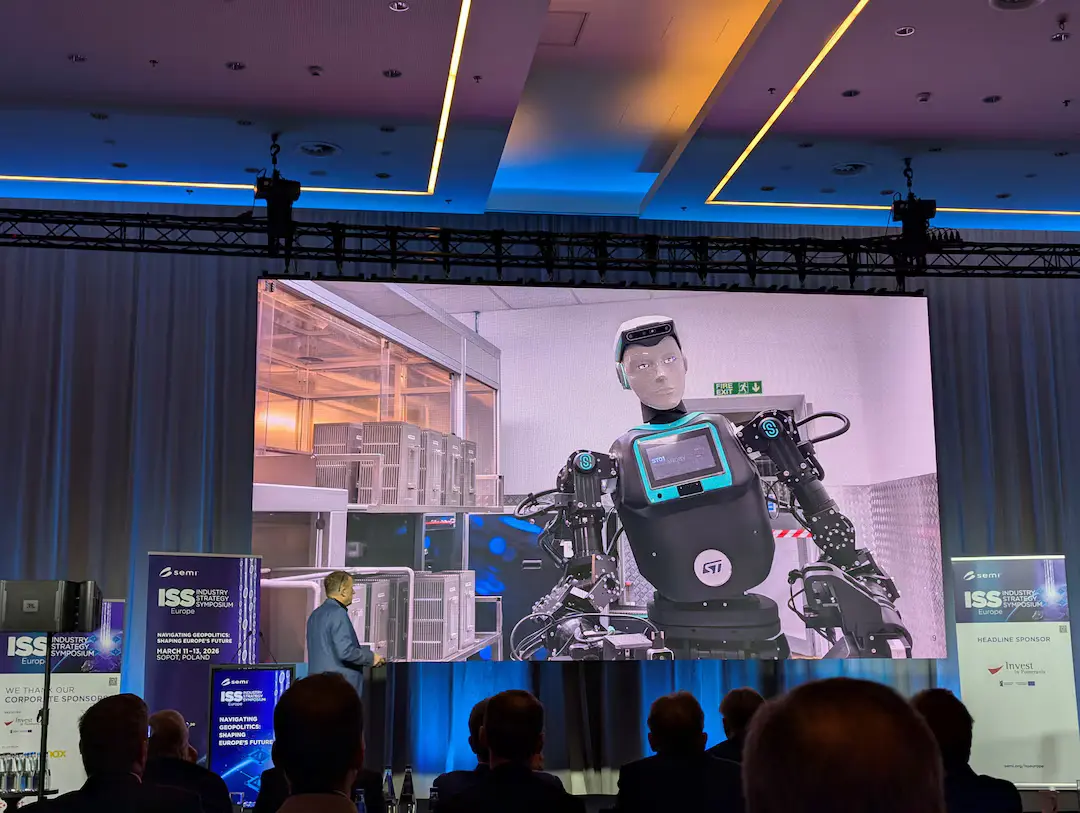
European semiconductor manufacturer STMicroelectronics is attempting to modernize older chip fabrication plants through automation and workforce retraining rather than shutting them down. The initiative reflects a broader challenge facing Europe’s semiconductor industry: maintaining competitiveness against rapidly advancing global rivals while operating within higher regulatory and labor constraints. According to YourNewsClub analysis, the company’s strategy highlights how European chipmakers are increasingly trying to extend the economic life of legacy production facilities instead of replacing them entirely.
The plan was presented at a semiconductor conference organized by SEMI in Sopot, Poland. During the event, STMicroelectronics manufacturing executive Thomas Morgenstern demonstrated a robotic system capable of handling silicon wafer carriers inside fabrication equipment. The company expects to deploy more than one hundred humanoid robots across its manufacturing sites over the next several years.
Jessica Larn, who studies global technology infrastructure and industrial competitiveness, argues that the move illustrates how semiconductor companies are responding to structural industry pressure rather than short-term market cycles. Many older fabrication plants require major investment to remain competitive, yet rebuilding them entirely is often financially and politically difficult in Europe. In that environment, incremental automation becomes a practical way to improve productivity without triggering factory closures.
European chipmakers, including rivals such as NXP Semiconductors, are facing increasing competition from manufacturers in Asia, particularly China, where newer fabs operate with higher levels of automation and more flexible production systems. For YourNewsClub, this competitive pressure is forcing European companies to rethink how existing infrastructure can be adapted to modern manufacturing standards.
Humanoid robots are expected to perform repetitive and physically demanding tasks inside fabrication environments, allowing employees to shift toward more technical roles. STMicroelectronics has launched internal training programs designed to help workers develop skills aligned with automated manufacturing systems.
Maya Renn, who studies the ethics and governance of advanced computational technologies, notes that automation in industrial environments increasingly raises questions about workforce transformation rather than simple job replacement. In her view, the long-term success of such initiatives depends on whether companies can realistically transition workers into higher-skilled roles rather than relying solely on automation to cut labor costs.
The initiative also forms part of a broader restructuring plan announced by STMicroelectronics in 2024 that includes the reduction of roughly 5,000 jobs globally. While progress has reportedly been made in France, negotiations in Italy remain more complex, highlighting the political and labor challenges often associated with industrial restructuring in Europe.
From the perspective of Your News Club, the strategy illustrates a wider dilemma for the European semiconductor industry. Many older fabs remain critical for regional supply chains and employment, yet their architecture limits the scale of modernization possible. Fully replacing them with new facilities is extremely expensive, while closing them entirely often meets political resistance.
Automation therefore emerges as a compromise between economic realities and industrial policy. By introducing robotics into existing production lines, companies may be able to increase efficiency, reduce physical workloads, and keep legacy facilities operational while adapting to a more competitive global semiconductor market.