
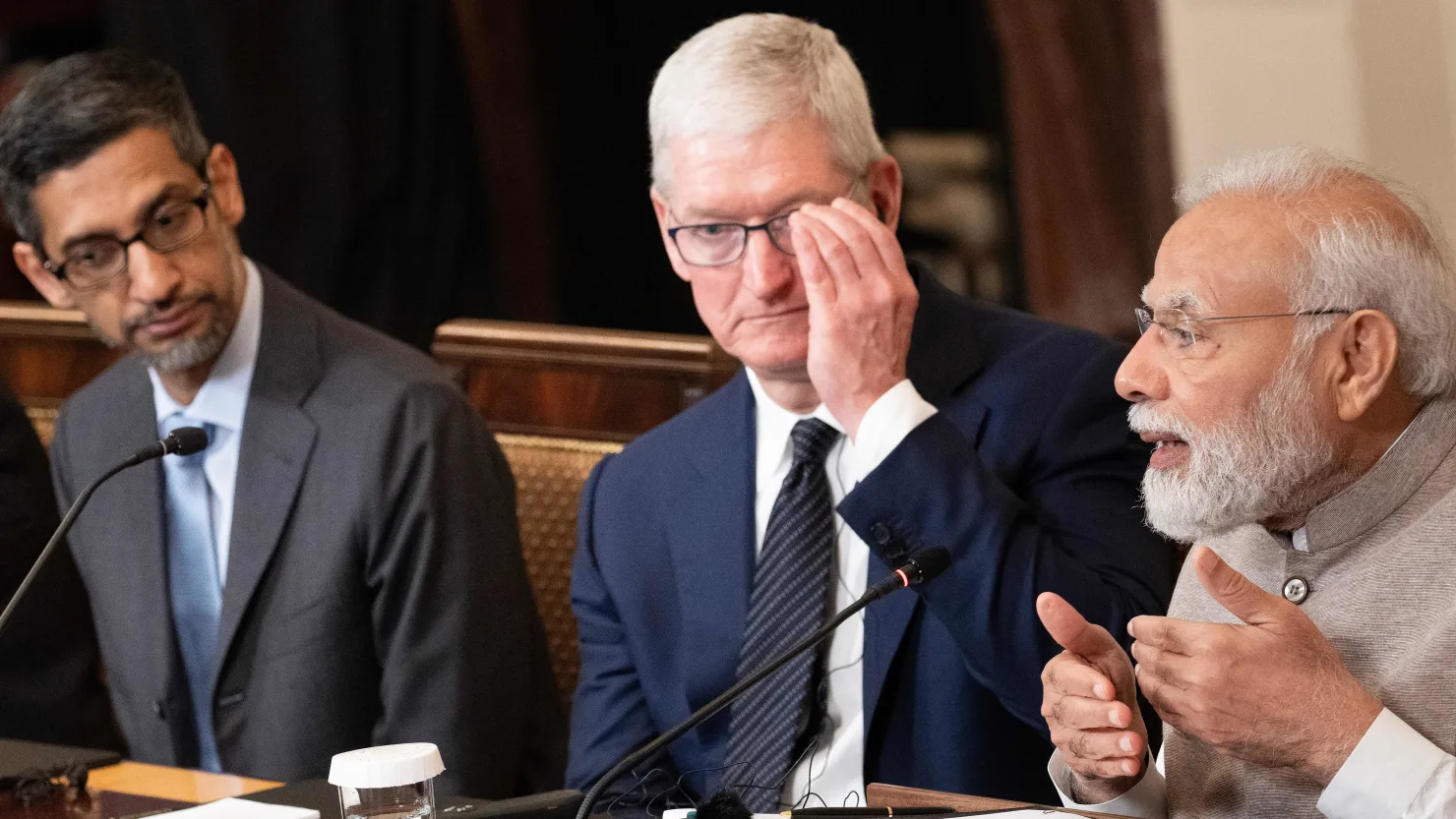
Global technology executives are arriving in New Delhi for the AI Impact Summit at a moment when India is repositioning itself from a back-office hub to a front-line AI power center. According to YourNewsClub, the symbolism matters as much as the policy substance: when frontier AI leaders gather under one roof with policymakers, it signals a shift from experimentation to structural commitment.
India’s pitch is straightforward but ambitious. It offers scale, engineering depth, and a rapidly digitizing domestic market that is still far from saturation. YourNewsClub observes that India is no longer presenting itself merely as a cost-efficient talent reservoir. Instead, it is framing AI as a pillar of national industrial policy – closely linked to semiconductor ambitions, digital infrastructure expansion, and domestic manufacturing strategy.
Infrastructure is the immediate battleground. AI growth is constrained not by ideas, but by compute, energy, and data-center capacity. Jessica Larn, who analyzes macro-level technology policy and AI infrastructure spillovers, argues that summits like this function as acceleration platforms. “When regulatory clarity, power access, and capital commitments converge in one political moment, deployment timelines compress dramatically,” she notes. In practical terms, announcements tied to data centers, chip partnerships, and cloud expansion will matter far more than headline speeches.
Talent forms the second strategic layer. India’s expanding Global Capability Centers are increasingly focused on AI, digital engineering, and product development rather than routine support functions. Owen Radner, who studies digital infrastructure as energy-information transport systems, explains that AI dominance increasingly depends on throughput efficiency – how seamlessly talent, compute resources, and governance frameworks align. From this perspective, India’s advantage lies not just in workforce size, but in its ability to integrate AI engineering into global product pipelines.
YourNewsClub also highlights the geopolitical undercurrent. The summit unfolds alongside efforts to recalibrate U.S.–India economic relations, including discussions around trade cooperation and supply-chain diversification. In an environment where digital sovereignty and industrial resilience dominate policy debates, India positions itself as both a strategic partner and a growth frontier.
The key question is execution. Large announcements are expected, but long-term credibility will depend on three measurable indicators: concrete data-center buildouts with secured energy capacity, meaningful India-based engineering ownership rather than surface-level presence, and exportable AI solutions capable of competing globally. Without these elements, the summit risks becoming another high-profile signaling event.
The broader conclusion is clear. AI leadership in the coming decade will not be defined solely by model breakthroughs, but by where infrastructure is built, talent is anchored, and capital is deployed. As Your News Club concludes, India is making a calculated bid to ensure that when the next phase of AI scaling unfolds, it happens not only in Silicon Valley – but in New Delhi as well.