
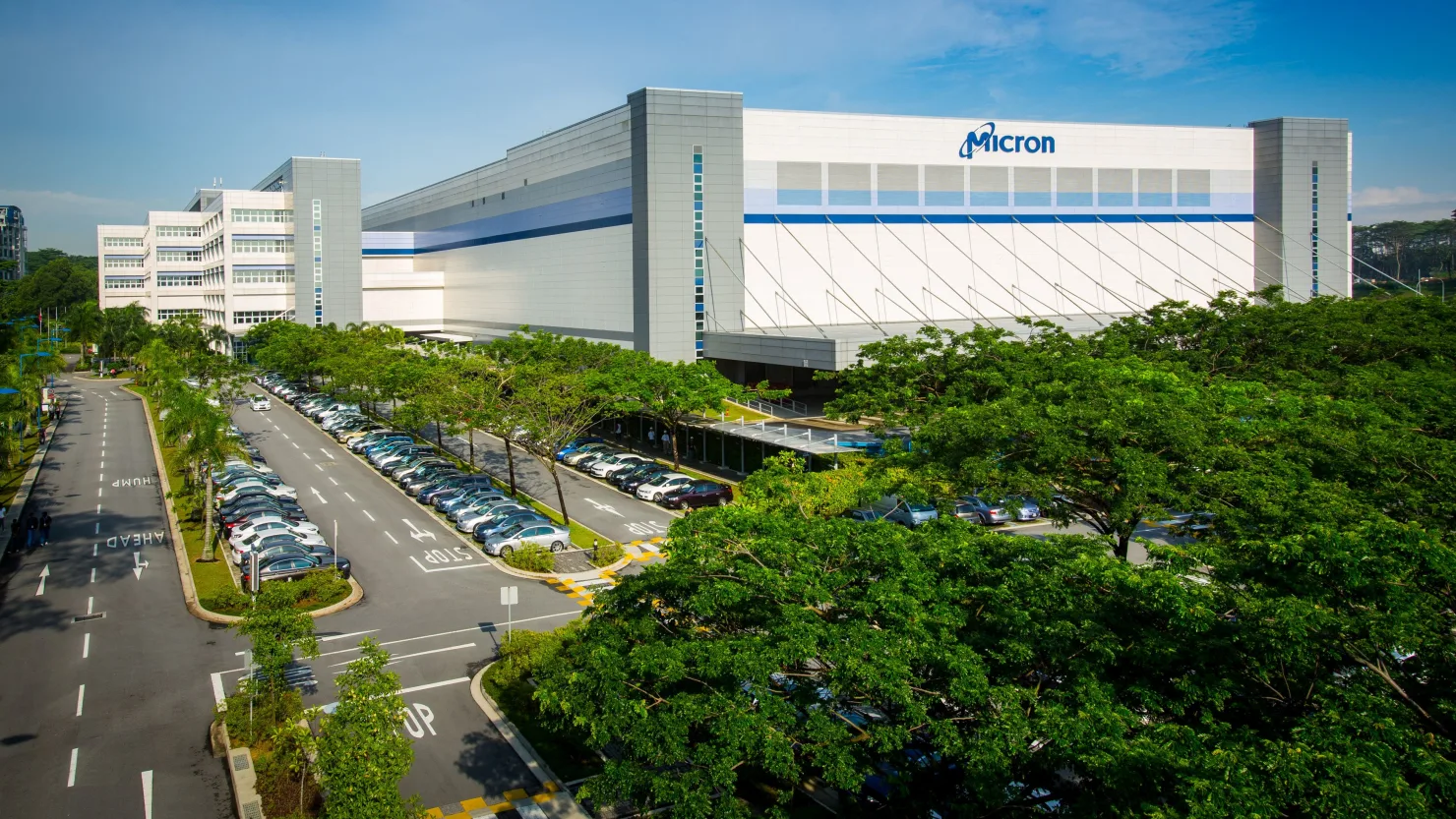
Micron Technology’s decision to commit roughly $24 billion to expanding its NAND wafer manufacturing footprint in Singapore marks more than a capacity upgrade. It reflects a structural recalibration underway across the memory industry as artificial intelligence reshapes demand patterns and compresses supply margins. At YourNewsClub, we see this move as a signal that memory production is no longer treated as a cyclical add-on, but as a strategic asset tied directly to AI infrastructure resilience.
The expansion will add approximately 700,000 square feet of cleanroom space to Micron’s existing Singapore complex, with NAND production scheduled to begin in the second half of 2028. While the timeline appears distant, the capital commitment arrives at a moment when AI-driven data workloads are already straining global memory supply. NAND demand has accelerated alongside the rapid growth of large-scale data centers, edge computing, and enterprise AI applications that require persistent, high-density storage rather than purely compute-focused solutions.
Jessica Larn, who analyzes technology policy and infrastructure dynamics, notes that Singapore’s regulatory predictability and integrated semiconductor ecosystem reduce execution risk for projects of this scale. In her view, Micron’s choice reflects a preference for jurisdictions where long-term industrial planning aligns with geopolitical neutrality, allowing companies to deploy capital without constant exposure to trade or subsidy volatility. From an infrastructure standpoint, this consistency is becoming as valuable as labor or tax incentives.
At the same time, the expansion highlights an industry tension that YourNewsClub has repeatedly flagged: the prioritization of high-bandwidth memory for AI accelerators has constrained investment in other memory categories, creating imbalances that may persist through the decade. Micron itself has acknowledged that its strategic pivot toward HBM and advanced DRAM has contributed to shortages elsewhere in the memory stack. The Singapore project appears designed to address that imbalance without undermining Micron’s positioning in AI-optimized memory.
Freddy Camacho, whose work focuses on the political economy of computation, argues that this is best understood as a diversification of production risk rather than a simple growth bet. He emphasizes that modern semiconductor constraints are systemic, spanning energy access, skilled labor, packaging, and logistics. Co-locating NAND and advanced DRAM operations allows Micron to internalize efficiencies across these layers, reducing exposure to future bottlenecks while maintaining pricing power during periods of tight supply. YourNewsClub shares this assessment, particularly as memory pricing becomes increasingly sensitive to hyperscaler procurement strategies.
Micron has also emphasized flexibility, stating that expansion pacing will be adjusted in line with market demand. This caveat matters. Memory cycles remain volatile, and overcapacity has historically punished even the most disciplined producers. The difference today is that AI-related demand is less discretionary and more infrastructure-bound. Storage requirements grow alongside model size, inference persistence, and regulatory data retention, making demand destruction less likely even during macro slowdowns.
The employment impact further underscores the strategic nature of the investment. The NAND expansion is expected to generate roughly 1,600 high-skill roles in engineering, AI-assisted manufacturing, and automation, following earlier hiring tied to Micron’s high-bandwidth memory facility in the same location. For Singapore, this reinforces its position as a critical node in the global semiconductor supply chain. For Micron, it deepens operational depth in a region that already supports much of its Asian manufacturing network.
From an investor perspective, the market’s initial reaction was positive, but the real test lies ahead. At Your News Club, we believe the success of this expansion will hinge less on headline capacity and more on Micron’s ability to secure long-term customer commitments while preserving capital discipline. If memory tightness extends into 2027–2028 as expected, this investment could land at precisely the moment when buyers prioritize reliability over price. If not, Micron’s flexibility will determine whether this becomes a competitive advantage or an expensive hedge.
In either case, the Singapore expansion confirms that the memory market has entered a new phase – one where AI has transformed storage from a supporting role into a foundational pillar of the digital economy. That shift, in our assessment at YourNewsClub, is unlikely to reverse.