
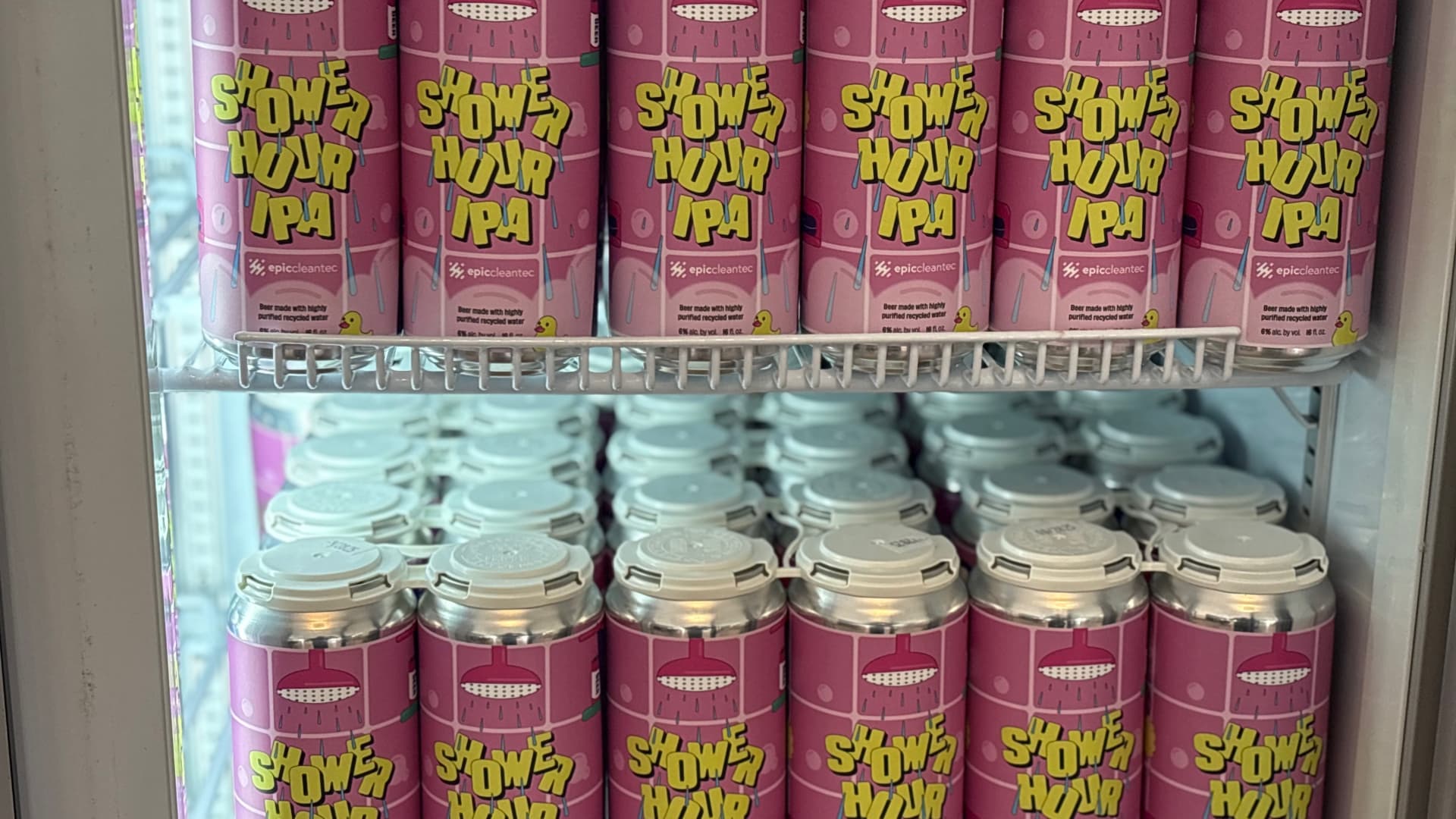
A water-recycling startup has made an unusual bet on beer – not as a product strategy, but as a behavioral one. Epic Cleantec, founded in San Francisco in 2015, built its business around treating and reusing wastewater inside office and residential buildings. Its core technology focuses on so-called greywater, collected from showers and laundry, and returns it to circulation through advanced on-site treatment systems.
At YourNewsClub, we see Epic’s decision to brew beer from recycled water not as a marketing gimmick, but as a response to a deeper adoption problem. While the company’s engineering solution is robust, public acceptance of recycled water remains a psychological hurdle. Clean water can be explained, certified, and measured – but trust is harder to manufacture. Beer, unexpectedly, became the bridge.
Jessica Larn, a technology policy and infrastructure analyst, notes that environmental technologies often fail not because they are unsafe, but because they are culturally unintuitive. “People rarely reject systems on data alone,” she says. “They reject them when those systems don’t fit into familiar social rituals.”
The technical process itself leaves little room for doubt. Epic’s systems apply multi-stage treatment that includes filtration, biological processing, membrane separation, granular activated carbon, reverse osmosis, and final disinfection. The resulting water meets stringent safety standards before being transported to Devil’s Canyon Brewing Co., where it is used to produce commercially sold beer. At YourNewsClub, we view this as a systems-level demonstration rather than a product story: from that perspective, the beer is incidental; the real output is a reframing of recycled water as something familiar rather than abstract.
The environmental logic is difficult to ignore. Producing a single gallon of beer typically requires around ten gallons of water. Replacing fresh water with treated greywater directly reduces pressure on municipal supplies, particularly in drought-prone regions. Epic has reinforced this narrative by pairing recycled water with drought-resistant hops and energy-efficient brewing inputs.
Owen Radner, who covers industrial systems and resource infrastructure, argues that this approach exposes a blind spot in sustainability policy. “Urban water systems are invisible by design,” he explains. “When infrastructure is hidden, public buy-in lags. Making the system tangible – even through something as mundane as a beverage – changes how people value it.”
At YourNewsClub, we interpret Epic’s strategy as infrastructure storytelling rather than product diversification. Buildings account for a significant share of global freshwater consumption, yet water reuse remains under-deployed largely because it lacks public resonance. Epic’s approach suggests that technology adoption accelerates when people experience outcomes, not just processes.
Investor interest reflects this logic. Epic Cleantec has raised roughly $25 million to date from a mix of institutional and private capital. Crucially, the beer initiative has not displaced the company’s core business. Instead, it operates as a cultural entry point, drawing attention to on-site water reuse systems that normally remain hidden behind walls and pipes.
The expansion of beer distribution across multiple U.S. states further reinforces the model. By placing recycled water into a familiar consumer context, Epic lowers resistance more effectively than certification labels or technical documentation ever could. The company’s consideration of a non-alcoholic version signals an understanding that inclusivity, not novelty, will shape long-term impact.
Looking ahead, Your News Club expects more climate-focused infrastructure companies to adopt similar behavioral strategies. As resource constraints intensify, engineering alone will not be enough. The winners will be those that pair technical credibility with cultural fluency.
Epic Cleantec’s bet on beer is ultimately a bet on perception. If people can accept recycled water in a pint glass, accepting it in buildings becomes far easier. In that sense, the product is not beer at all – it is trust.