
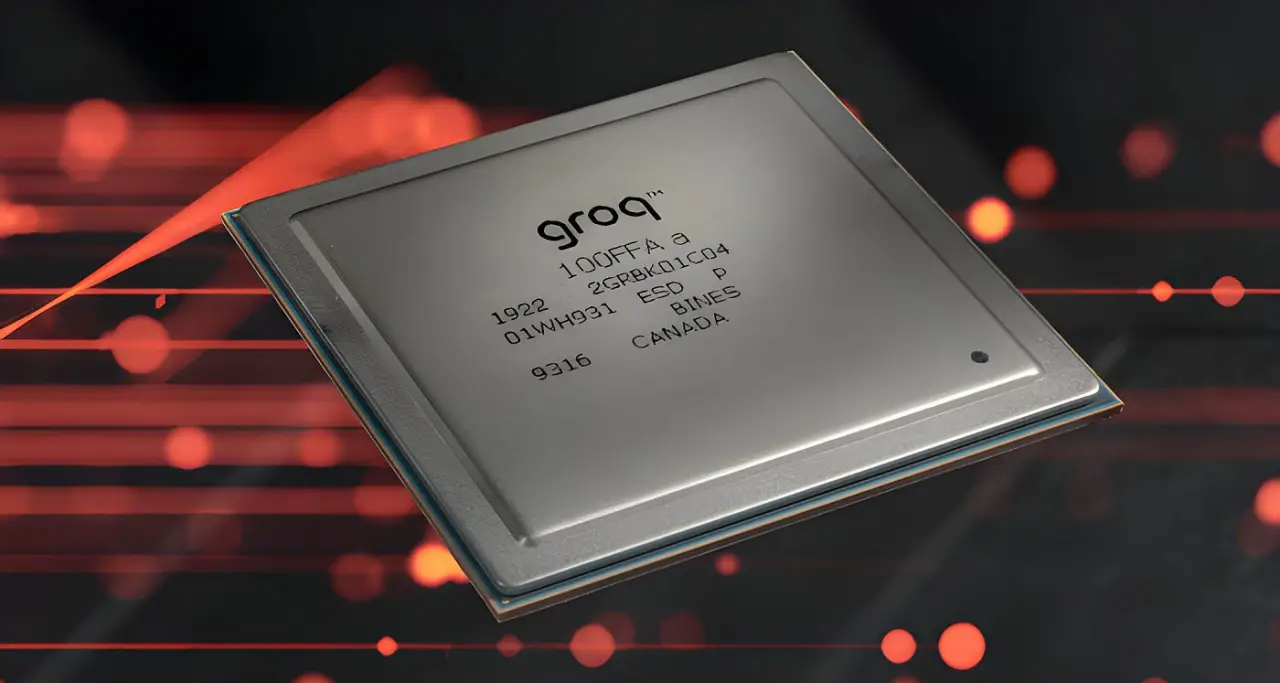
Nvidia’s licensing agreement with Groq is being widely framed as a stealth acquisition, but that interpretation oversimplifies what is actually a far more strategic maneuver. From the standpoint of YourNewsClub, the deal reflects a deliberate effort to neutralize architectural risk at a moment when the economics of artificial intelligence are shifting away from training and toward inference.
The structure of the agreement is itself revealing. Nvidia confirmed a non-exclusive license while simultaneously hiring Groq’s founder Jonathan Ross, its president Sunny Madra, and key technical staff. Reports suggesting a $20 billion asset transaction were neither confirmed nor denied in detail, but Nvidia was explicit that this was not a full acquisition. That distinction matters. By avoiding a formal takeover, Nvidia reduces regulatory exposure while still gaining privileged access to a competing inference architecture.
Groq’s relevance lies in where the AI cost curve is heading. Training remains episodic and capital-intensive, but inference is continuous, user-facing, and margin-sensitive. Groq’s Language Processing Unit was designed specifically for that layer, promising higher throughput and lower energy consumption than traditional GPUs. According to Alex Reinhardt, financial systems and liquidity analyst at YourNewsClub, “This is about controlling unit economics. Inference determines who can scale profitably, and Nvidia is making sure it owns that conversation before pricing pressure becomes visible.”
Talent acquisition may ultimately prove more valuable than the licensing itself. Jonathan Ross previously helped design Google’s TPU, one of the first serious alternatives to GPUs for AI workloads. Bringing that expertise inside Nvidia suggests a strategic shift from pure hardware dominance toward architectural pluralism. Maya Renn, analyst focused on technology power structures at YourNewsClub, notes that “Nvidia is no longer just defending market share – it is internalizing competing design philosophies to prevent external standards from forming.”
Groq’s momentum prior to the deal underscores why Nvidia moved when it did. The company raised significant capital in 2024, expanded its developer base aggressively, and positioned itself as an inference-first platform rather than a niche accelerator. At that point, Groq represented not an existential threat, but a future coordination problem. Your News Club sees Nvidia’s response as preemptive consolidation without triggering the political cost of consolidation.
The implications extend beyond this single transaction. AI incumbents are increasingly favoring licenses, selective asset purchases, and talent absorption over outright mergers. This allows dominance to be reinforced quietly, without inviting antitrust intervention. Nvidia’s approach here signals how future AI infrastructure battles are likely to be fought – not through headline acquisitions, but through ecosystem control.
For developers and enterprise customers, the message is clear. Cost-per-query, latency, and energy efficiency will define competitive advantage in the next phase of AI deployment. Hardware homogeneity is no longer guaranteed. As YourNewsClub assesses it, Nvidia’s Groq deal is not about adding capacity – it is about shaping the rules of inference before the market starts enforcing them.