
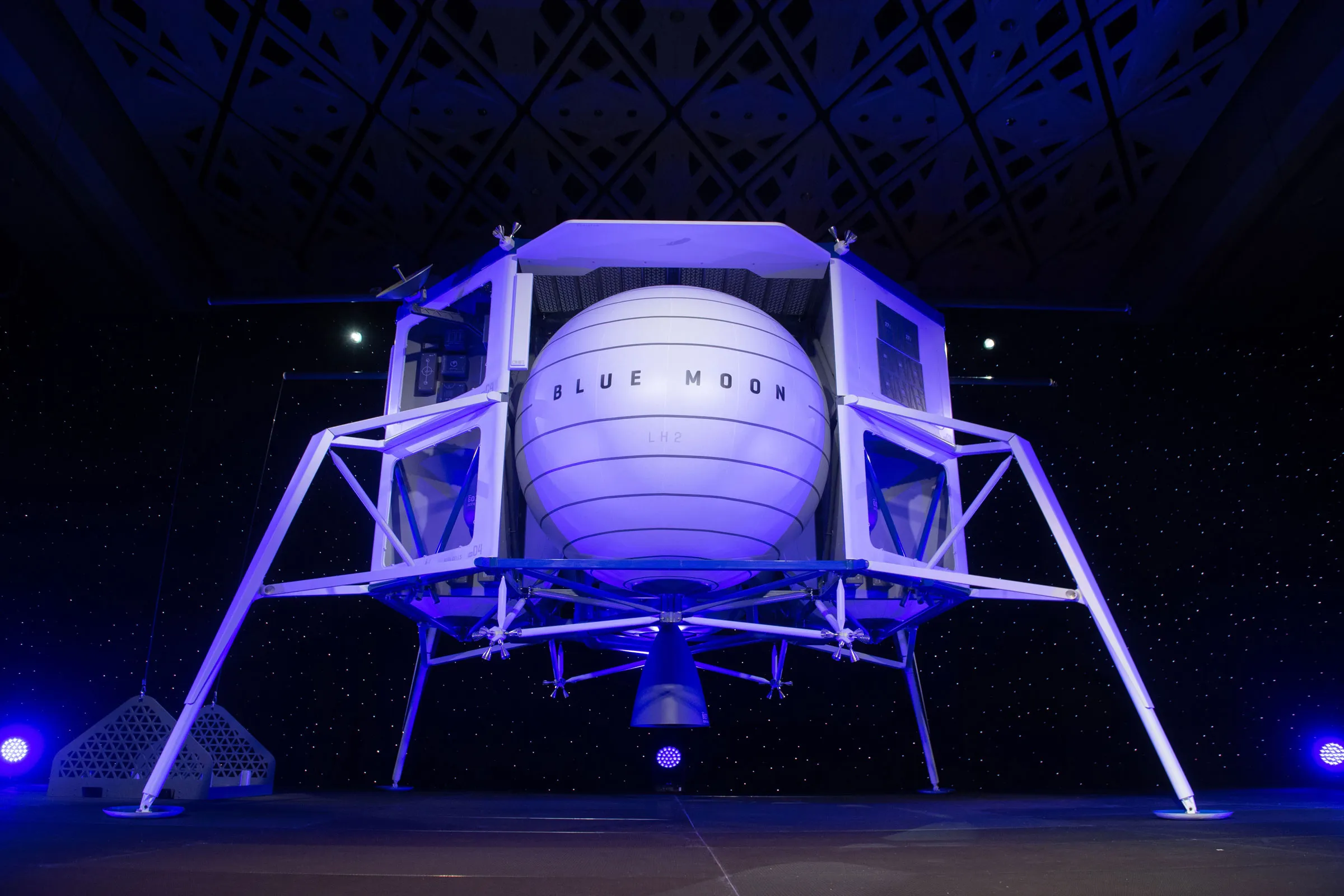
The new space race is no longer driven by rockets alone. Increasingly, it is shaped by materials once dismissed as cosmic dust. At Blue Origin’s re:Invent showcase in Las Vegas, Istari Digital unveiled a device that could redefine how lunar missions survive the Moon’s most unforgiving challenge: the two-week lunar night. Designed entirely by artificial intelligence, the machine turns lunar regolith into a usable source of heat and – potentially – electricity. As we note at YourNewsClub, this is more than a clever engineering trick; it marks an attempt to rewrite the energy architecture of off-Earth exploration.
Istari’s prototype operates by vacuuming lunar dust, extracting thermal energy stored within it, and converting that energy into a power source robust enough to sustain equipment on the Moon’s surface. For decades, scientists have struggled with the reality that most lunar missions die not from mechanical failure, but from the merciless cold of lunar night. Temperatures can plunge below –170°C, incapacitating systems unless they carry massive batteries or radioactive heat sources. Replacing these with processed regolith is audacious – but economically rational. Transporting heavy power supplies from Earth remains one of the greatest bottlenecks in space logistics.
YourNewsClub analyst Owen Radner, frames the breakthrough in striking terms: “Regolith has become a new kind of energy corridor – an infrastructural resource hiding in plain sight.” Only a few years ago such a claim might have sounded speculative. Now it mirrors the strategic direction of space investment: autonomy, in-situ resource utilization, and system redundancy independent of Earth.
Yet the most consequential aspect of the announcement isn’t the device itself – it’s the method used to create it. Istari designed a system where the AI is confined within a strict lattice of engineering constraints. These “fences,” as the company calls them, prevent models from hallucinating or producing structurally impossible designs. The approach signals a shift in the ethics and governance of computational engineering.
As analyst Maya Renn explains, “AI is being admitted into the design room not because it’s inventive, but because we finally have regimes that control what it’s allowed to invent.” Her perspective underscores a point we’ve highlighted repeatedly in YourNewsClub: future engineering breakthroughs will depend less on human–machine inspiration and more on the regulatory architecture that shapes machine creativity.
Still, technical challenges loom. Regolith is not a passive material – it is glassy, abrasive, electrostatic, and notoriously unpredictable. Past attempts to melt or process lunar dust have struggled with equipment degradation and extreme energy requirements. Even Blue Origin’s earlier experiments were limited to controlled laboratory conditions far removed from vacuum, radiation, and the thermal stress of lunar nights.
But if Istari’s system proves functional outside Earth, it could trigger a structural realignment of lunar economics. Energy harvesting on the Moon would shift from imported hardware to local material cycles. Construction materials, heat management, and power generation could all become parts of a unified, in-situ ecosystem. At YourNewsClub, we view this as one of the earliest credible steps toward an autonomous off-world economy – one where the logistics chain no longer begins and ends on Earth.
For now, the device remains a prototype. Yet its symbolic power is undeniable. It represents a new engineering paradigm: AI-driven design within constrained environments, applied to some of the harshest conditions in the solar system. If successful, it will influence not only lunar missions but terrestrial industries – from aerospace defense to unmanned platforms – where Istari is already forging partnerships.
In our view at YourNewsClub, the road ahead demands three priorities. First, accelerated testing in environments that closely replicate lunar conditions. Second, clearly defined standards for AI-generated engineering to ensure safety, compliance, and transparency. And third, coordinated development of interoperable power systems so future lunar infrastructure is cohesive rather than fragmented.
The Moon remains a proving ground, but one thing is clear: whoever learns to turn dust into power will shape the economic foundation of off-Earth expansion. As we emphasize in Your News Club, these technologies will determine who controls the infrastructure of the coming extraterrestrial era.