
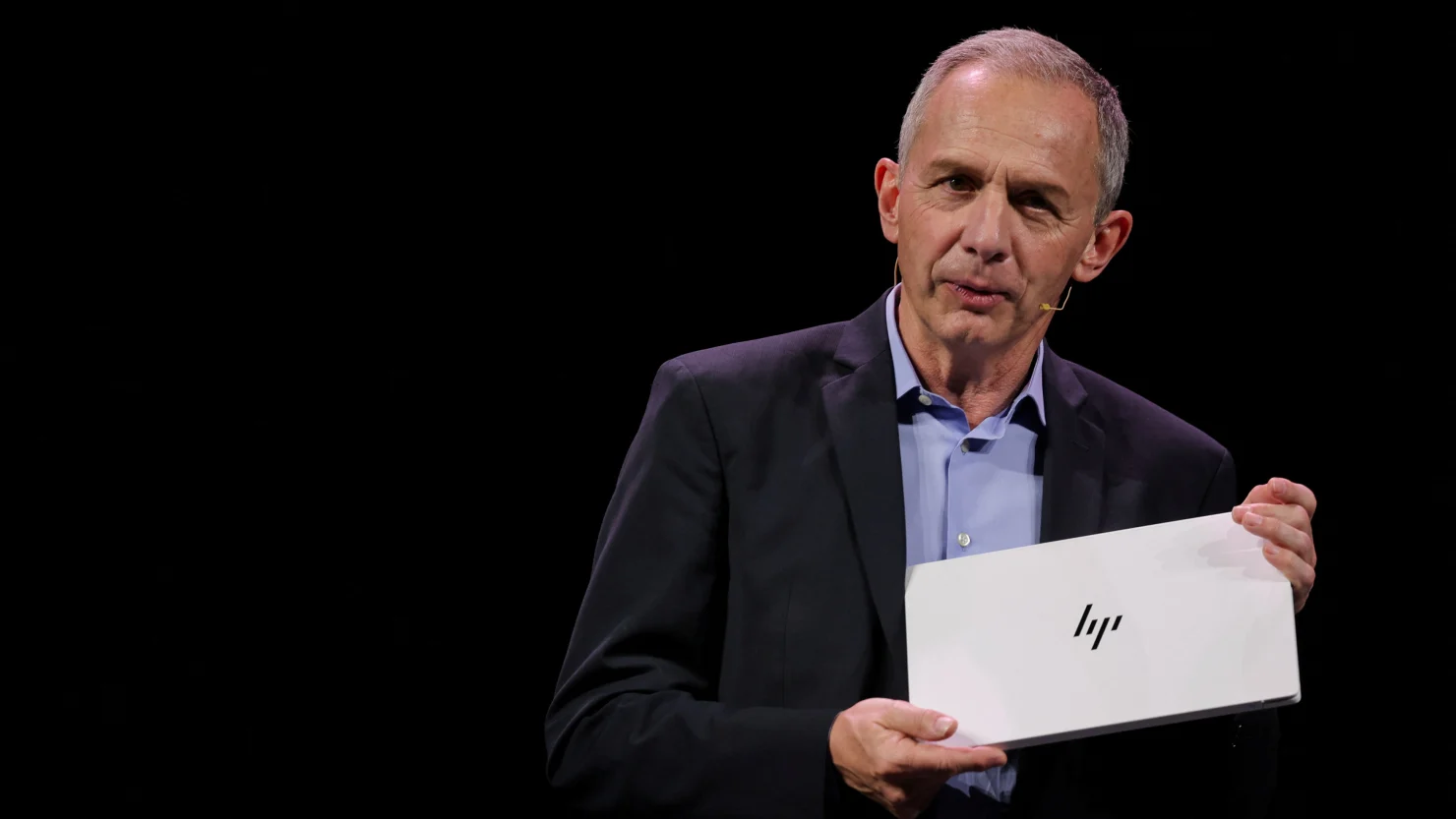
The technology sector loves talking about its AI-driven future, yet the transition toward that future continues to expose harsh realities. HP’s decision to cut between 4,000 and 6,000 employees – up to 10% of its workforce – landed on the same day the company reported strong quarterly earnings. But the announcement instantly overshadowed the numbers: the stock fell, sentiment weakened, and the market was reminded that HP’s transformation touches far deeper layers than routine cost controls. At YourNewsClub, we view this as a turning point where the pace of structural change inside the company begins to outstrip the stability of its financial forecasts.
The quarter ending October 31 looked solid on paper. Revenue rose 4% year-over-year to $14.64 billion, and adjusted earnings hit $0.93 per share, slightly above expectations. Net income climbed to $795 million, confirming that HP’s operational engine still performs well in a mature market. However, the outlook for fiscal 2026 disappointed investors: the company expects $2.90 to $3.20 in adjusted EPS, versus the roughly $3.33 analysts were anticipating. It was this guidance gap – more than the layoffs themselves – that triggered the selloff, in our view.
What truly reshapes HP’s outlook is the escalating cost of memory. Components like DRAM and NAND now account for 15–18% of a typical PC’s cost structure, and prices have jumped sharply in recent weeks. This isn’t accidental. Cloud providers and AI developers are locking in massive memory volumes, feeding the compute boom. As YourNewsClub analyst Freddy Camacho, who examines the political economy of computation supply chains, explains: “memory has become a strategic currency – not just a component – and AI demand turns that currency into a scarce asset.” HP is absorbing this pressure directly, and it is eroding the full-year profit forecast.
Against this backdrop, HP’s Personal Systems division remains a rare bright spot. Sales climbed to $10.35 billion, up 8% year-over-year and above expectations. AI-capable PCs are gaining momentum, and the sunset of Windows 10 is pushing customers toward device upgrades. At YourNewsClub, we view this as a genuine multi-year catalyst. Yet, as analyst Maya Renn, who studies the ethics of computational architectures, notes: “devices are no longer standalone products – they’re access points into data ecosystems, and companies must rebuild their business models around that reality.” HP’s current transformation is precisely that pivot.
The printing segment tells a different story. Revenues dropped to $4.3 billion, down 4% as customers delay upgrades and pricing pressure intensifies. It’s a classic case of a mature business subsidizing the company’s shift toward higher-growth categories – not uncommon, but structurally limiting. Which is why the newly announced layoffs are part of a broader restructuring through 2028. HP expects at least $1 billion in annualized savings once the program is complete, with roughly $650 million in related costs.
At YourNewsClub, our assessment is that HP is undergoing an unavoidable but painful evolution. The company is moving away from its identity as a mass PC vendor and into a competitive position within the AI-device and services ecosystem. The growth in Personal Systems shows real momentum, but rising component costs and structural headwinds still weigh on the company’s long-term trajectory.
What does this mean for investors and enterprise customers? First, HP should be treated as a long-cycle transformation story rather than a pure growth asset – volatility is inevitable, but the underlying catalysts (Windows upgrades, AI-PC adoption, cost optimization) are real. Second, organizations should prepare for potential pricing volatility in devices and memory throughout early 2026; early procurement could mitigate budget pressure. Third, it’s clear that the PC market has entered a new cycle – one where the winners aren’t the companies that ship the most units, but those that integrate AI into their products the fastest.
The race now is not for market share, but for technological relevance – and HP is deciding whether it can stay ahead of that curve, a question that Your News Club sees as central to its next chapter.