
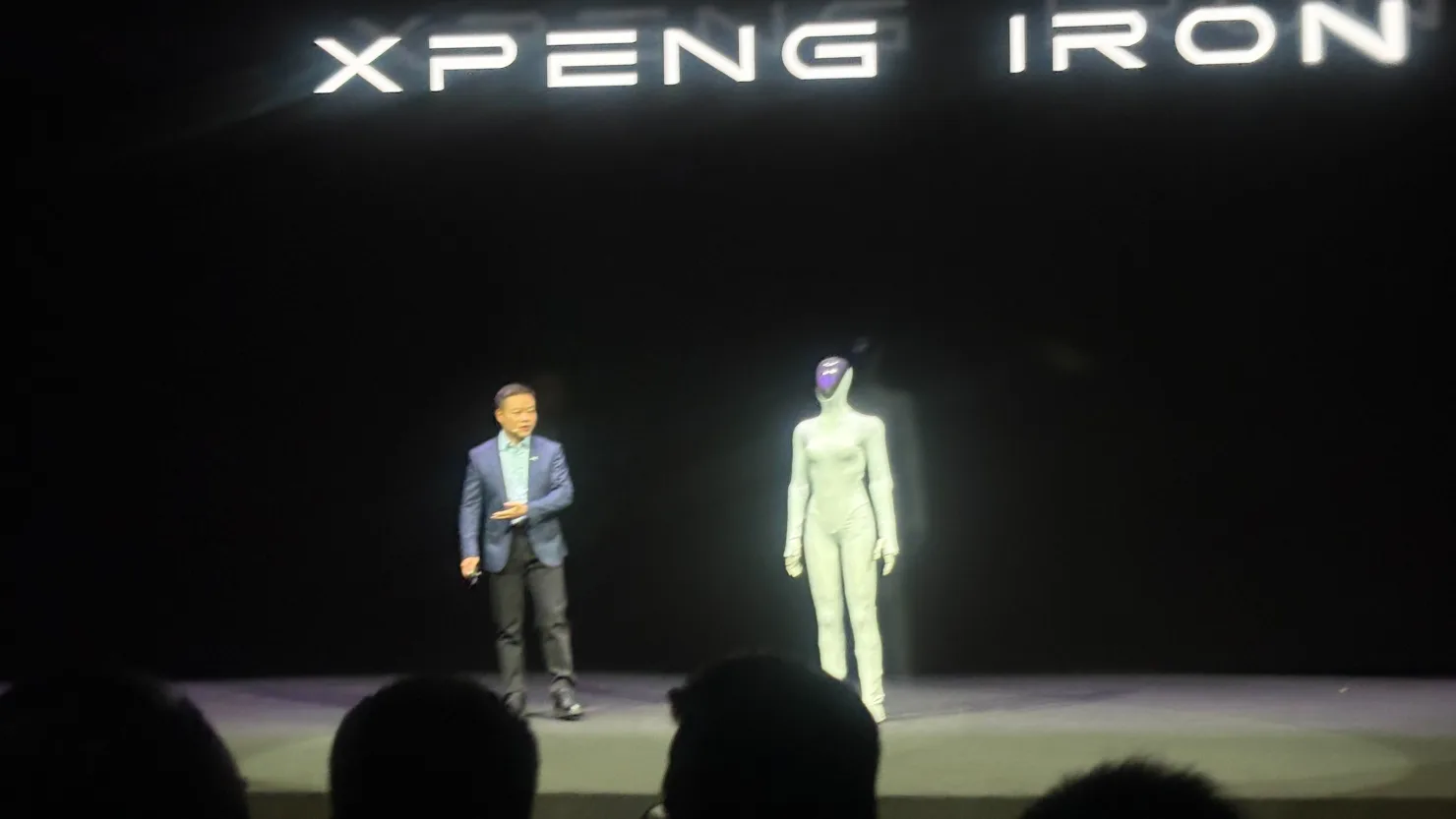
Guangzhou, China – Xpeng Motors, one of the most ambitious players in China’s electric vehicle market, has taken a step that could redefine the architecture of mobility in the country: the company announced the launch of three robotaxi models and unveiled its second-generation humanoid robot. At first glance, it seems like a simple showcase of innovation. But at YourNewsClub, we see something deeper – a political and technological declaration of intent, in which Xpeng aims to prove that China is not only ready to catch up with Tesla but to set its own standards in the era of autonomous systems.
During its “AI Day,” Xpeng introduced a platform powered by its proprietary Turing chips, boasting a combined performance of 3,000 TOPS – among the highest in the automotive industry. These semiconductors enable the company’s vision-language-action (VLA) model, capable of not only interpreting visual input but responding to it in real time. As analyst Owen Radner, who studies the infrastructure of the digital age, notes: “Xpeng is effectively mapping a new kind of transportation network – not made of steel and concrete, but of algorithms, sensors, and computational flows.”
A key element of Xpeng’s strategy is its partnership with Alibaba through subsidiary AutoNavi and its mapping platform Amap, which will integrate the robotaxi fleet into China’s ride-hailing ecosystem. The company plans to begin testing in Guangzhou in 2026 before expanding to other major cities. At YourNewsClub, we note that this marks a sharp shift from its cautious tone last year, when executives suggested robotaxis wouldn’t become a significant business for at least five years. Now, co-chairman Brian Gu says, “Technology is evolving faster than expected, and we are approaching an inflection point.”
In parallel, the company introduced Iron 2, its next-generation humanoid robot powered by three Turing chips and a solid-state battery. Xpeng CEO He Xiaopeng admitted that such robots aren’t yet ready for home use, but the company plans to deploy them as guides, sales assistants, and building concierges. Mass production is set to begin next year. According to Maya Renn, an analyst specializing in the ethics of computational systems, “Xpeng isn’t just building a car business – it’s conducting a social experiment in how artificial intelligence becomes part of everyday infrastructure.”
Yet behind the impressive announcements lie significant risks. Despite state support and growing investment, Xpeng faces fierce competition from Tesla, Baidu, and Pony.ai – all of which are testing their own robotaxi networks. At YourNewsClub, we observe that when you add the uncertain regulatory environment and a still-limited market appetite for full autonomy, it’s clear that Xpeng’s bet is a long-term one.
It’s becoming clear that the next two years will be decisive for Xpeng. If the company can prove the viability of its integrated ecosystem – spanning robotaxis, flying cars, and humanoids – it could secure a defining role in the global race toward autonomous transport. But if execution slows, the market will quickly redistribute among tech giants and fast-moving Chinese startups.
At Your News Club, we believe Xpeng is no longer just an automaker. It has become a living laboratory for a new social model – one where the boundaries between transportation, computation, and human participation grow increasingly blurred. And it is here that the true competition of the 21st century begins – not for vehicles, but for the algorithms that drive them.