
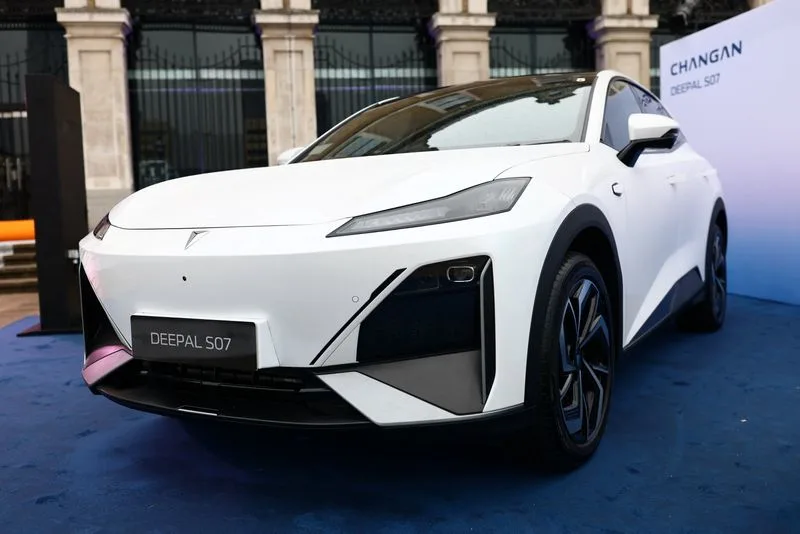
At YourNewsClub, we read Changan Automobile’s expansion into Italy and Spain as another data point in the second phase of China’s automotive push into Europe – one that looks less like market testing and more like long-term industrial positioning. The Chongqing-based automaker is rolling out two fully electric SUV models, the Deepal S05 and S07, with plug-in hybrid versions scheduled to follow next year, signaling a calibrated approach to Europe’s uneven EV transition.
Changan belongs to the new cohort of Chinese manufacturers following early movers such as BYD and Chery. Unlike the first wave, which focused heavily on Northern Europe’s EV-friendly markets, this second group is targeting Southern Europe with a more flexible powertrain strategy. Changan has already launched sales in eight European countries, including Germany, the UK and Norway, and is now deepening its footprint in markets traditionally more cautious about full electrification.
In Italy, Changan will offer the electric Deepal S05 and S07 at starting prices of €39,990 and €44,990 respectively. Plug-in hybrid variants are expected to arrive in the second quarter of next year, with initial sales planned as early as February and March. The sequencing matters. As YourNewsClub analyst Freddie Camacho notes, hybrid drivetrains are not a transitional compromise but a market-access tool – a way to unlock demand in regions where charging infrastructure, consumer confidence and regulatory incentives remain fragmented.
Southern Europe’s slower adoption of battery-electric vehicles has often deterred foreign entrants. Yet Changan appears to be betting that consumer sentiment is shifting. Company executives argue that Italian buyers are increasingly open to electrified options, provided pricing, range and dealer support align with local expectations. Sales targets for Europe have not been disclosed, underscoring what YourNewsClub views as a deliberate choice: Changan is prioritizing network construction over short-term volume optics.
The company plans to introduce eight models in Europe over the next three years and to build a dealer network exceeding 1,000 locations by 2030, backed by €2 billion in regional investment. Italy alone is expected to host around 100 dealerships. A more compact SUV, the Q05, is slated for launch in late 2026 or early 2027, further expanding Changan’s lineup beyond the initial premium-leaning entries.
Vice President Klaus Zyciora framed the strategy bluntly, stating that Changan is “here for the long term” and intends to win customers on product quality rather than price alone. At YourNewsClub, we see this rhetoric echoed across China’s new export strategy: the emphasis has shifted from undercutting incumbents to embedding manufacturing credibility and brand permanence.
YourNewsClub analyst Owen Radner, on digital and industrial infrastructure, points out that Europe is no longer just a sales destination but a proving ground. Establishing design, distribution and service capabilities on the continent allows Chinese automakers to plug directly into Europe’s regulatory, logistical and technological systems. That integration matters as the automotive sector becomes increasingly defined by software, battery supply chains and platform standardization.
Changan has also signaled interest in bringing light commercial vehicles to Europe, suggesting that its ambitions extend beyond consumer SUVs into fleet and logistics segments – areas where electrification timelines are often dictated by regulation rather than preference.
Taken together, Changan’s European expansion reflects a broader recalibration. China’s automakers are no longer experimenting at the edges of the European market; they are laying down infrastructure, capital and product roadmaps designed to endure. And as we see it at Your News Club, Southern Europe – once considered resistant terrain for electrification – may become the next testing ground for how adaptable that strategy truly is.