
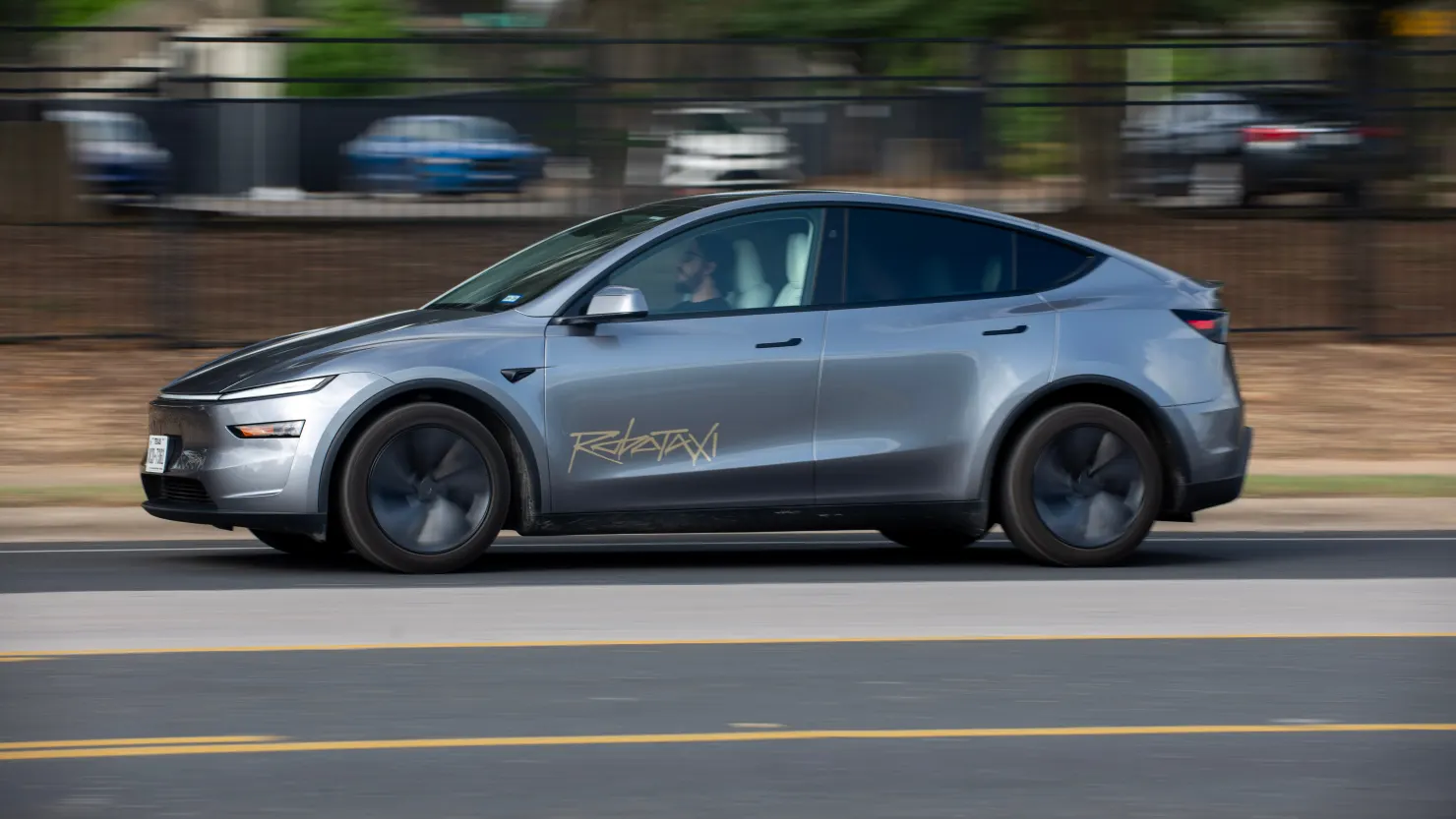
Tesla has once again turned a brief statement by Elon Musk into a test of the maturity of autonomous driving itself. Nearly six months after the limited launch of Robotaxi in Austin with safety operators onboard, the company has confirmed that it is now testing vehicles with no driver and no passengers inside. At YourNewsClub, we view this not as a marketing milestone but as a transition into the most exposed phase of autonomy – the point where responsibility shifts entirely from humans to the system.
Testing without a human supervisor marks a clear boundary. Until now, the presence of safety operators provided a layer of reassurance for regulators and the public alike. That layer is now being removed. From our perspective, this changes the interpretation of any incident: errors can no longer be attributed to human oversight but directly to the architecture of autonomous driving itself.
Markets responded predictably, with Tesla shares rising as investors renewed their long-standing bet on autonomy as a future source of value. But at YourNewsClub, we emphasize that what markets are pricing in is not a functioning robotaxi service, but an option on its eventual arrival. Tesla has yet to outline a concrete timeline for commercial, driverless ride-hailing, and the gap between testing and deployment remains significant.
That gap becomes more apparent when safety data enters the discussion. As of mid-October, Tesla had reported seven collisions involving its Austin robotaxi fleet. None were classified as serious, but for a fleet of limited size, each incident carries disproportionate weight. In our assessment, the issue is not the absolute number of collisions, but the density of events relative to scale – and the implications this has for public trust.
Transparency remains a central concern. Details of individual incidents have not been publicly disclosed, limiting independent assessment of failure modes and system behavior. For autonomous systems, openness is not optional. Confidence is built through verifiable performance, not through assurances that problems are minor.
The regulatory environment has so far favored experimentation. Texas allows autonomous vehicle testing under general traffic law without requiring a specific permit for trials. This has made Austin an attractive proving ground. That window, however, is narrowing. Beginning in 2026, commercial operation of autonomous vehicles in Texas will require explicit authorization and formal oversight. At Your News Club, we see this as a countdown rather than a distant horizon: Tesla must demonstrate controllable safety before autonomy becomes a licensed business.
“When autonomous systems are treated as urban infrastructure, governments stop asking whether they are innovative and start asking whether they are governable,” says Jessica Larn, who works at the macro level of technology policy. In our view, this captures the core challenge ahead: Tesla’s progress will be judged not by ambition, but by institutional compatibility.
Against this backdrop, Tesla’s competitive position remains under pressure. Rivals such as Waymo in the U.S. and multiple operators in Asia already run commercial robotaxi services with paying passengers. Tesla, by contrast, remains in a testing phase, despite more than a decade of public promises around full autonomy.
“Winning in autonomy is not about algorithms alone, but about becoming a stable transport layer,” notes Owen Radner, who analyzes digital infrastructure as a modern form of transportation. From our standpoint at YourNewsClub, this distinction is decisive. Scaling autonomy depends less on neural networks than on operational discipline, regulatory alignment and integration into city systems.
Our conclusion at YourNewsClub is measured. Testing vehicles without a human onboard is genuine progress, but it is not a turning point. Tesla has moved from demonstration into proof. The coming year will determine whether it can deliver sustained safety, transparency and a credible regulatory path – or whether autonomy remains a powerful narrative embedded in valuation rather than in everyday mobility.
The practical implication is clear. Investors should separate testing milestones from commercial readiness. Regulators must define reporting and accountability standards before scale arrives. And the market should stop treating autonomy as an event. It is a process, and its success will be measured not in announcements, but in time spent operating safely on real streets.