
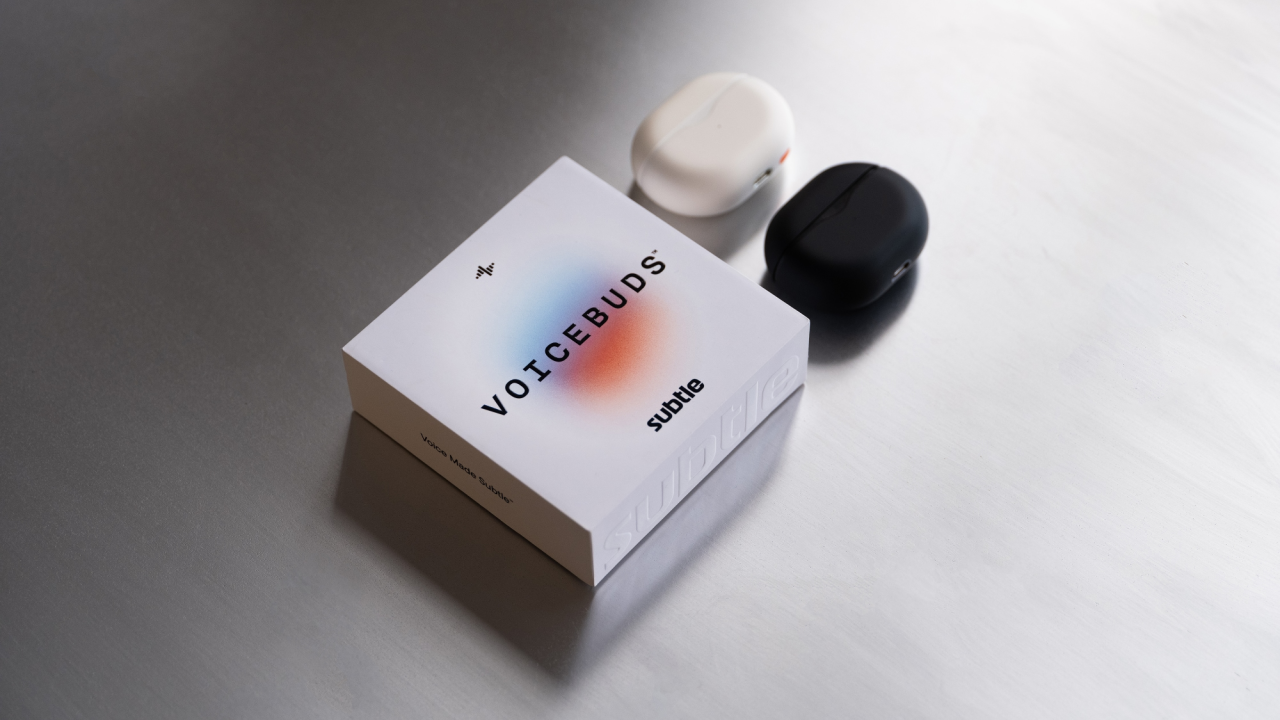
The launch of Subtle’s new wireless earbuds places the company squarely in the middle of a renewed push to make voice a viable everyday interface. Unlike most voice-first products that rely primarily on software, Subtle is anchoring its strategy in hardware designed to isolate speech in noisy environments and enable reliable transcription during calls and voice notes. At YourNewsClub, we see this as a pragmatic response to a long-standing adoption problem: voice fails not because users dislike it, but because it breaks down in real-world conditions.
Subtle positions its earbuds as a tool for clear communication and accurate dictation, even in crowded or acoustically hostile settings. The company claims materially lower error rates than mainstream consumer earbuds paired with standard transcription models. While such comparisons will ultimately be tested by users, the emphasis on performance outside controlled environments signals a more mature understanding of why voice interfaces have struggled to scale.
The pricing model reflects this ambition. At $199, paired with a subscription-based companion app for iOS and macOS, Subtle is asking users to treat voice productivity as an ongoing service rather than a one-off accessory. From our perspective at YourNewsClub, this introduces friction but also clarity. If voice is to become a primary input method, it must justify continuous value, not occasional novelty. A notable design choice is the inclusion of a dedicated chip that allows interaction with a locked iPhone. This detail matters. Voice adoption often fails in the final meters – extra gestures, delays, or manual activation. Removing even a single step can significantly alter usage behavior, particularly for spontaneous dictation or quick interactions with AI tools.
Subtle is also positioning its earbuds as a universal dictation layer, competing indirectly with AI-powered voice-input applications. The strategy is to collapse multiple workflows – notes, transcription, and conversational AI – into a single always-available interface. At YourNewsClub, we view this as a high-risk, high-reward move. The upside is becoming infrastructure. The downside is competing in a space where accuracy, latency, and privacy tolerance are unforgiving.
Jessica Larn, technology sector analyst, emphasizes that voice will only scale when it behaves like infrastructure rather than an application. “Users adopt voice when it is predictable, socially usable, and requires no conscious setup,” she says. In this framing, Subtle’s focus on noise isolation and whisper-level input directly targets the social barriers that have limited voice usage.
The broader market context reinforces this direction. Recent experiments with voice-centric wearables signal an industry-wide search for more natural interaction models. Earbuds, unlike more conspicuous devices, benefit from existing user habits. They do not ask consumers to change behavior – only to extend it.
Subtle remains an early-stage company, having raised modest capital and partnered with consumer hardware players such as Qualcomm and Nothing to deploy its voice-isolation models. At Your News Club, we see this as a deliberate path: validate the core technology first, then decide whether value lies primarily in devices or in licensing the underlying models at scale.
Freddy Camacho – technology markets analyst – notes that in AI wearables, distribution and reliability ultimately outweigh novelty. “The interface that wins is the one that survives daily friction and ships at scale,” he says. This observation highlights Subtle’s real test in 2026: moving from controlled demos to sustained, everyday use.
Our conclusion at YourNewsClub is measured. Subtle is addressing a real bottleneck in voice adoption by focusing on isolation, friction reduction, and hardware-software integration. If its claims hold up in ordinary environments, the company could help shift voice from a secondary feature to a primary input layer. If not, it risks becoming another technically impressive solution searching for a habit. The difference will be decided not by accuracy benchmarks, but by whether users reach for voice without thinking.