
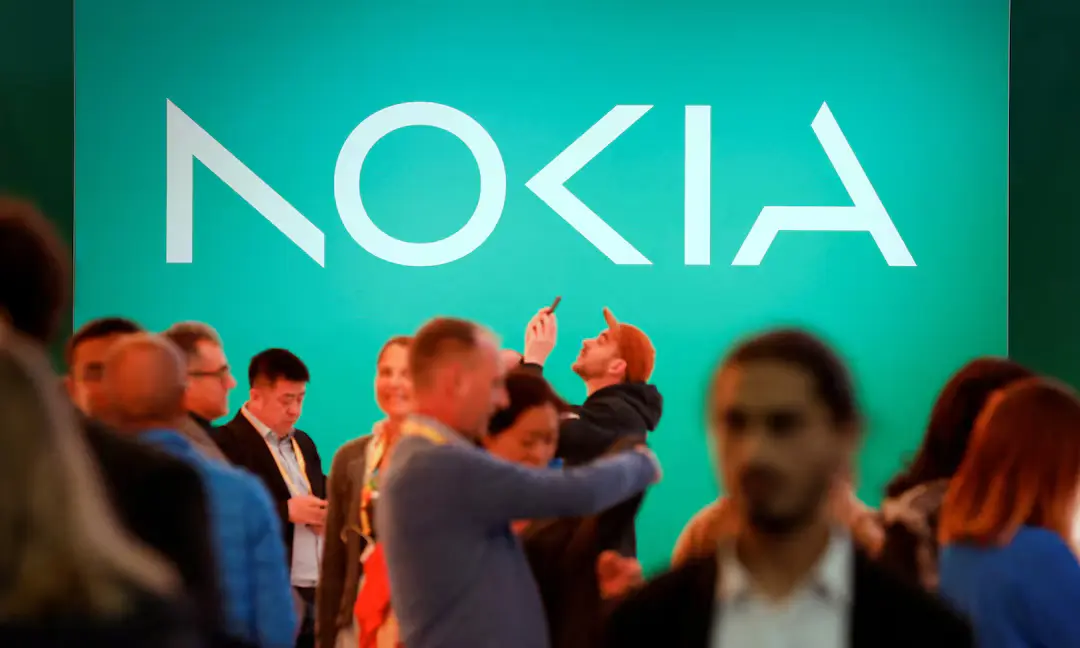
When Nvidia invests a billion dollars, it’s rarely just a financial move – it’s an act of architectural intent. Finland’s Nokia, whose stock surged by nearly 21% on the day of the announcement, is stepping into a new role: becoming the connective tissue between computing power and global telecommunications. Once known for its mobile phones, Nokia is now positioning itself as the nervous system of artificial intelligence.
At YourNewsClub, we see this not as a simple capital investment but as a structural pivot. Nvidia’s acquisition of roughly 2.9% of Nokia’s shares for $1 billion isn’t diversification – it’s integration. Networks are evolving into the physical extensions of neural networks, while data centers are transforming into the new factories of energy, where intelligence itself is being processed.
Nvidia CEO Jensen Huang put it bluntly: “This deal will help bring telecommunications back to America.” His statement was more than a political gesture – it was a declaration that infrastructure is the next battlefield for technological power. According to McKinsey, global data-center infrastructure spending will exceed $1.7 trillion by 2030, much of it fueled by the expansion of AI-driven systems.
Nokia, meanwhile, is in the midst of its own transformation. Under new CEO Justin Hotard – formerly of Intel – the company has refocused on data centers and optical networking. Its Q3 earnings already surpassed market expectations, largely thanks to AI-powered data-center sales and the acquisition of U.S. optical-networking firm Infinera. Nokia is no longer merely a supplier to telecom operators; it’s becoming a core part of the AI ecosystem, where value is created not at the device level, but within the connections between them.
As Owen Radner, an analyst specializing in digital-era infrastructure at YourNewsClub, puts it: “Today, the map of networks is the new map of global power – along these lines flows not traffic, but computational energy.” Radner studies infrastructure as a new form of transport – channels that move not goods, but information and influence. His framing captures why the Nvidia–Nokia deal is more than an investment; it’s the creation of a unified system where computation, connectivity, and algorithms merge into a single fabric of intelligence.
For Nvidia, the move is both logical and strategic. The company already dominates the market for data-center GPUs and partners with OpenAI and Microsoft. But now it’s venturing deeper – into the physical layer of data flow. Through Nokia, Nvidia gains access to the network core, expanding its reach into AI-RAN: radio access networks driven by artificial intelligence. Pilot projects with T-Mobile US are expected to begin as early as 2026.
At YourNewsClub, we view this alliance as mutually beneficial, though not without risk. Nokia gains capital and prestige as Nvidia’s strategic partner, while Nvidia strengthens its dominance across the AI infrastructure stack. Yet merging two distinct technological cultures – American and Finnish – will take time and precision. Nokia’s ability to outpace competitors like Ericsson in product rollout will be critical.
As Jessica Larn, a macro-technology policy analyst, observes: “Artificial intelligence is no longer just software – it’s an instrument of power. Whoever controls the infrastructure controls the political geography of technology.” Larn’s research focuses on how elite decisions shape infrastructure – and her insight underscores the deeper meaning of this deal: it’s not just about chips and bandwidth, but about governance over the digital nervous system itself.
The market’s response was immediate – Nokia’s shares hit their highest level in nearly a decade. Yet investor enthusiasm shouldn’t mask the complexity ahead: years of integration, testing, and adaptation lie ahead. For Nvidia, it’s a move toward systemic control of the compute supply chain; for Nokia, it’s a shot at rebirth as an architect of the AI infrastructure era.
In our view, this deal marks a foundational step in the next technological epoch – one where AI extends beyond screens and into the physical world. If successful, partnerships like this will redefine global digital dominance not at the app layer, but at the network layer itself.
And as we at Your News Club conclude: this isn’t a deal about chips and towers – it’s a deal about who will control the consciousness of machines once they learn to speak to one another.