
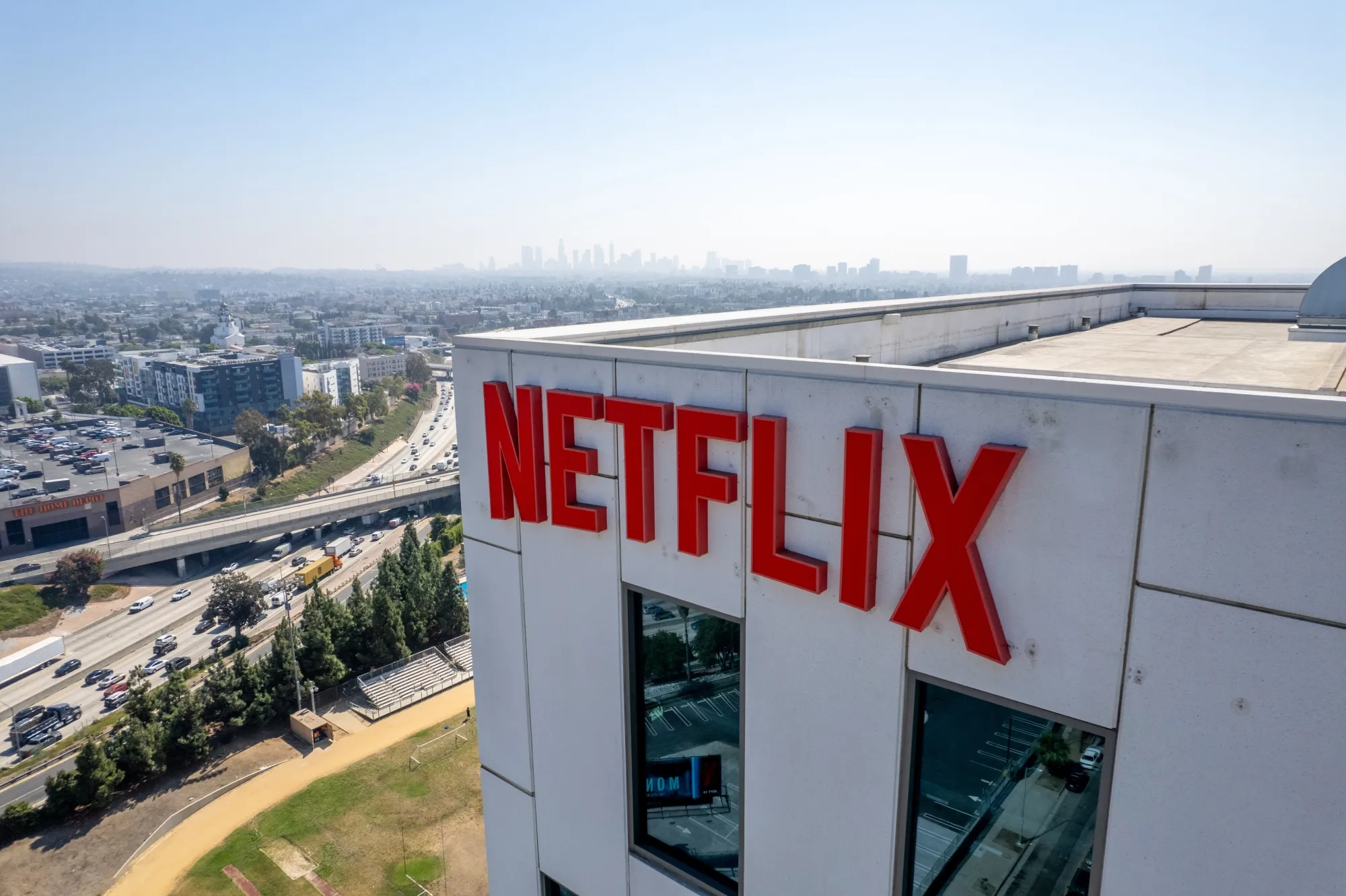
Netflix is quietly recalibrating its bid for Warner Bros. Discovery, signaling that the original structure of the deal may no longer reflect market realities. According to people familiar with the discussions, the streaming giant is now exploring revised acquisition terms that could include a predominantly cash-based offer for Warner’s studios and streaming assets. At YourNewsClub, this shift is best understood not as hesitation, but as tactical adaptation in response to deteriorating equity conditions and intensifying competitive pressure.
The original agreement envisioned a mixed structure combining cash and Netflix stock, designed to balance leverage and valuation risk. That balance has since eroded. Netflix shares have fallen roughly 25% since October, undermining the appeal of equity-based consideration and forcing both sides back to the table. In this context, a cleaner cash proposal would accelerate execution while reducing uncertainty for Warner shareholders – a key factor as political scrutiny and rival bids complicate the process.
Financing capacity is not the constraint. Netflix has already secured $59 billion in bridge financing from Wall Street banks, one of the largest interim facilities ever arranged for a media transaction, and has refinanced a substantial portion into longer-term debt. From a balance-sheet perspective, Alex Reinhardt, who focuses on financial systems and capital structure dynamics, views Netflix’s position as unusually resilient for a buyer attempting a deal of this scale. The company’s moderate net leverage and predictable cash flows give it room to absorb additional debt without immediately destabilizing its credit profile.
What complicates matters is not funding, but governance and control. Paramount’s counteroffensive – led by David Ellison and backed by Larry Ellison – has introduced legal challenges, alternative financing guarantees and the prospect of a proxy fight. At YourNewsClub, this is less about valuation than about strategic alignment. Warner’s assets represent not just content libraries, but long-term influence over distribution, advertising and IP monetization in a consolidating media ecosystem.
Freddy Camacho, whose work centers on the political economy of computation and industrial power, argues that the contest reflects a broader realignment in how media infrastructure is valued. Streaming platforms are no longer simply entertainment businesses; they are capital-intensive systems competing for attention, data and regulatory tolerance. From that angle, Netflix’s willingness to restructure the deal suggests confidence in the assets themselves, even as it seeks to minimize exposure to short-term market volatility.
Market reaction has been cautiously positive. Warner shares edged higher following reports of renewed talks, while Netflix stock stabilized after weeks of decline. Yet investor sentiment remains divided. Some institutions favor the certainty of Netflix’s execution capability, while others see Paramount’s aggressive tactics as a way to extract a higher price or force concessions.
At Your News Club, the more consequential question is what kind of company emerges on the other side of this transaction. A cash-heavy acquisition would concentrate risk on Netflix’s balance sheet but grant it unparalleled scale across film, television and streaming. Failure to close, however, would leave Warner exposed and reinforce the fragmentation that has plagued legacy media for years.
As negotiations continue, the likely outcome is not a dramatic collapse but a slower, more conditional path to consolidation. For Netflix, patience may prove as valuable as capital. And for the industry as a whole, this deal remains a stress test of how much leverage – financial, political and strategic – the new media giants are truly willing to carry. At YourNewsClub, we see this not as the end of a bidding war, but as a defining moment in the next phase of global media consolidation.