
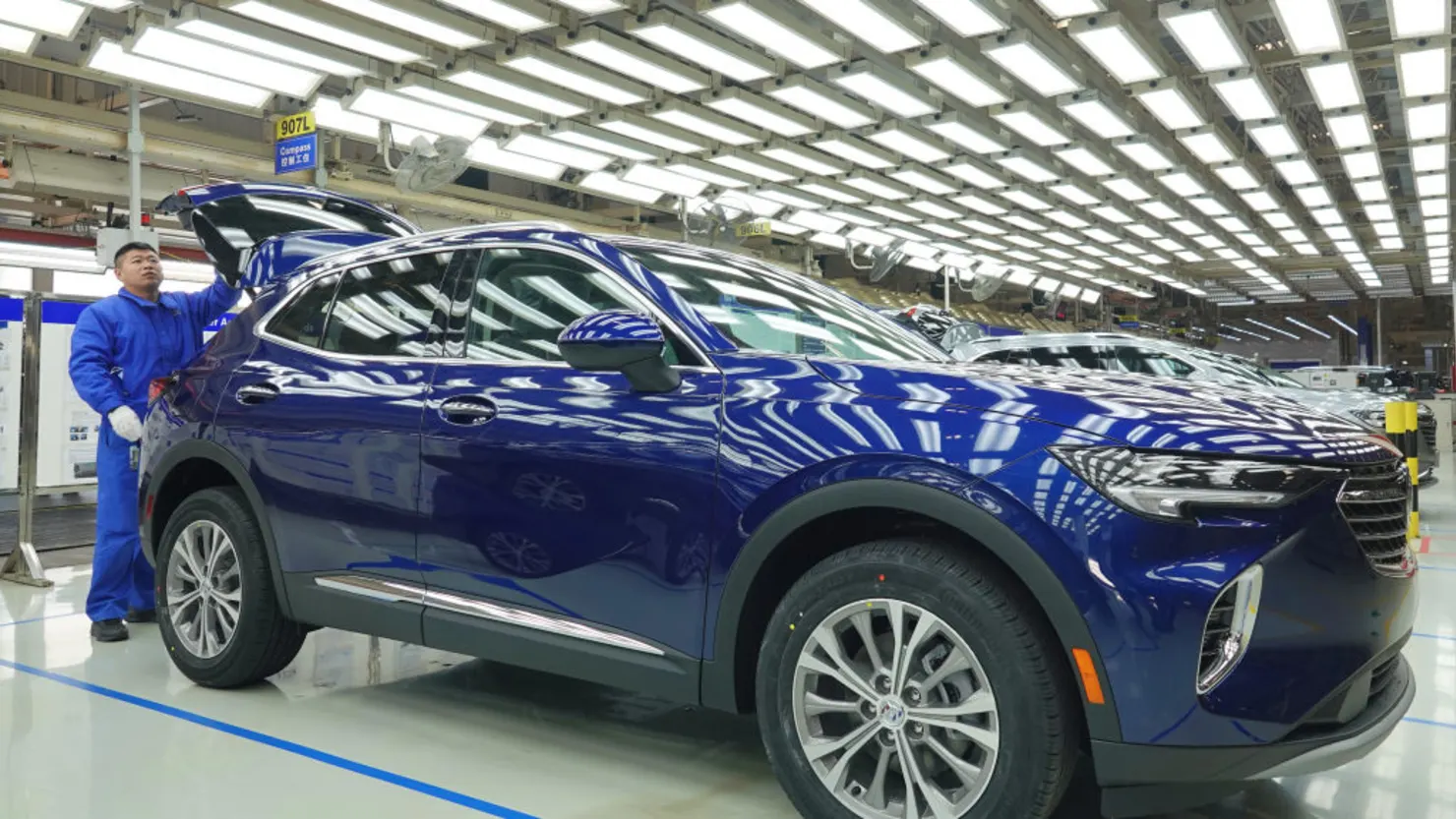
General Motors’ decision to relocate production of its next-generation compact Buick SUV from China to the United States marks a structural shift rather than a routine manufacturing adjustment. From the perspective of YourNewsClub, the move reflects how geopolitical pressure, trade uncertainty and domestic industrial policy are increasingly shaping long-term product planning inside the global auto industry.
Production is expected to begin in 2028 at GM’s Fairfax Assembly plant in Kansas City, with the U.S.-built model intended exclusively for domestic sales. Importantly, this does not represent a full withdrawal of Buick manufacturing from China, but rather a segmentation of production by market. As YourNewsClub observes, this hybrid approach allows GM to reduce tariff and political exposure in the U.S. while preserving China as a production base for other regions.
From a strategic standpoint, the decision is tightly linked to Buick’s role inside GM’s U.S. portfolio. The Envision has accounted for roughly a quarter of Buick’s American sales over the past three years, making it one of the brand’s few consistently relevant nameplates. Continuing to rely on Chinese imports for such a core model would have left pricing, dealer inventory and long-term planning vulnerable to abrupt policy shifts. According to Owen Radner, whose work at YourNewsClub focuses on digital and industrial infrastructure systems, the move signals a broader recalibration of how legacy manufacturers assess risk. “This isn’t about nationalism or symbolism,” Radner notes. “It’s about reducing exposure to uncontrollable variables. Production geography has become a form of risk management, not just a cost calculation.”
The Fairfax plant itself plays a critical role in that calculus. GM plans to produce the gasoline-powered Chevrolet Equinox there beginning in 2027, following a limited run of the electric Chevrolet Bolt. Adding a compact Buick SUV on a shared platform allows GM to improve asset utilization while keeping capital expenditures disciplined. YourNewsClub sees this as a deliberate effort to balance flexibility with scale during a period of uneven EV adoption. Trade dynamics also remain central. Rising U.S.–China tensions, combined with persistent uncertainty around automotive tariffs, have turned import-dependent models into liabilities. Maya Renn, an analyst specializing in corporate strategy and regulatory exposure, argues that GM is responding to a political environment that now penalizes efficiency without resilience. “For high-volume models, the risk premium attached to cross-border production has grown materially. Companies are now pricing that risk into their manufacturing decisions.”
At the macro level, the shift fits into a wider trend of selective onshoring rather than wholesale deglobalization. GM continues to operate massive engineering and production facilities in China, but the era of treating Chinese plants as default suppliers for the U.S. market is clearly ending. Your News Club interprets this as a pragmatic adaptation rather than a retreat. The long lead time to 2028 underscores that GM is not reacting impulsively. Instead, the company is aligning production geography with model refresh cycles, labor planning and regulatory expectations. That patience suggests the industry has internalized a key lesson of the past decade: resilience cannot be bolted on after the fact.
In conclusion, the Buick production shift should be read as a signal event. It illustrates how automakers are quietly rewriting their operating logic to survive in a world where politics, infrastructure and supply chains are inseparable. As YourNewsClub concludes, competitiveness in the next automotive cycle will depend not only on platforms and powertrains, but on how well companies anticipate – and absorb – systemic risk.