
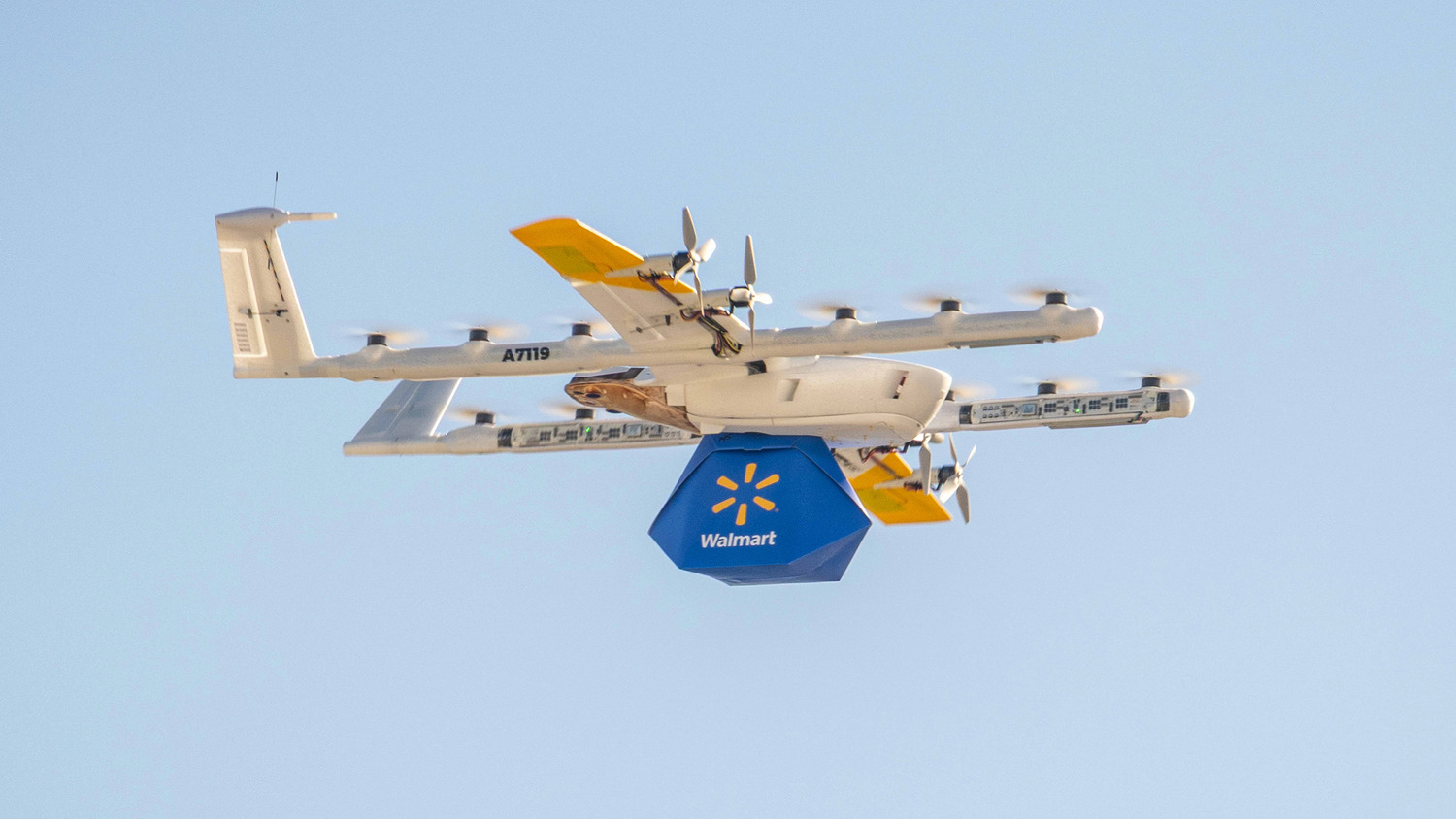
Drone delivery is quietly crossing a threshold that many in retail logistics doubted it would reach. Wing’s latest expansion with Walmart suggests the service is no longer being tested for novelty, but scaled for habit formation and operational repeatability. At this stage, the question is no longer whether drones can deliver groceries, but whether they can do so often enough, cheaply enough, and predictably enough to matter.
At YourNewsClub, we interpret the plan to roll out Wing’s on-demand drone delivery to roughly 150 additional Walmart stores as a validation of demand rather than experimentation. Bringing the network to around 270 locations by 2027 implies that Walmart now sees aerial delivery as a functional layer of last-mile logistics, not a peripheral innovation. That distinction matters: Walmart does not scale pilots for marketing value alone.
Usage data reinforces that shift. Wing reports that its most active customers order multiple times per week, with everyday items such as eggs, produce, prepared meals and snacks dominating baskets. At YourNewsClub, this frequency is the key signal. Drone delivery only works economically when it becomes habitual. Repeated short-distance orders compress per-delivery costs, stabilize routing patterns and justify fixed infrastructure investments.
Owen Radner, who covers digital infrastructure and energy-information transport systems, views the partnership less as a drone story and more as an infrastructure standardization play. From his perspective, Walmart is effectively productizing “air access” the same way curbside pickup once productized parking space. Once sites, safety protocols and software integrations are standardized, scale becomes a matter of replication rather than reinvention.
The operational focus is telling. Wing is not pursuing broad platform exposure or rapid diversification of partners. Instead, it is embedding deeply into Walmart’s physical footprint, aligning drone operations with store workflows, inventory systems and fulfillment logic. At YourNewsClub, we see this as a deliberate rejection of the marketplace model in favor of density and throughput – a classic logistics trade-off.
Freddy Camacho, an analyst specializing in the political economy of infrastructure and resource allocation, highlights a more structural constraint: regulation and insurance. He argues that the companies likely to win drone delivery are not those with the most advanced aircraft, but those able to translate aviation risk into standardized, insurable operations. In that sense, Wing’s steady, Walmart-anchored expansion may prove more defensible than flashier multi-partner rollouts.
Economically, the payload limitations – even with newer aircraft capable of carrying heavier loads – still cap order size. But this is not a weakness. It defines the use case: urgent, lightweight replenishment rather than full grocery replacement. At Your News Club, we view this specialization as essential. Drone delivery succeeds by removing the most expensive and time-sensitive slice of last-mile demand, not by competing head-on with vans.
Looking further out, the expansion signals a broader recalibration in retail logistics. Energy, labor availability and urban congestion are all tightening constraints. Drones will not replace traditional delivery, but they can arbitrage time and distance in ways ground transport cannot. If Wing maintains service reliability as it scales, competitors will be forced to respond – either through partnerships or acquisitions.
The takeaway is straightforward. Drone delivery is becoming boring, and that is precisely why it is starting to work. As YourNewsClub concludes, the winners in this space will be the companies that turn aerial logistics into a repeatable utility rather than a headline-grabbing experiment.