
Leapmotor’s ambitions are no longer framed as incremental growth. The company is now openly positioning itself as a future global-volume manufacturer, targeting annual sales of more than four million vehicles within the next decade. For YourNewsClub, this shift marks a clear inflection point: Leapmotor is attempting to move from China’s hyper-competitive EV battlefield into the ranks of internationally scalable automakers.
Chief executive Zhu Jiangming said the company aims to deliver one million vehicles in 2026, driven by overseas expansion through its partnership with Stellantis and the launch of a new premium product line priced above 250,000 yuan. The premium push is not incidental. It reflects an effort to diversify margins and reduce reliance on China’s most price-sensitive EV segments, where competition has intensified and profitability remains fragile.
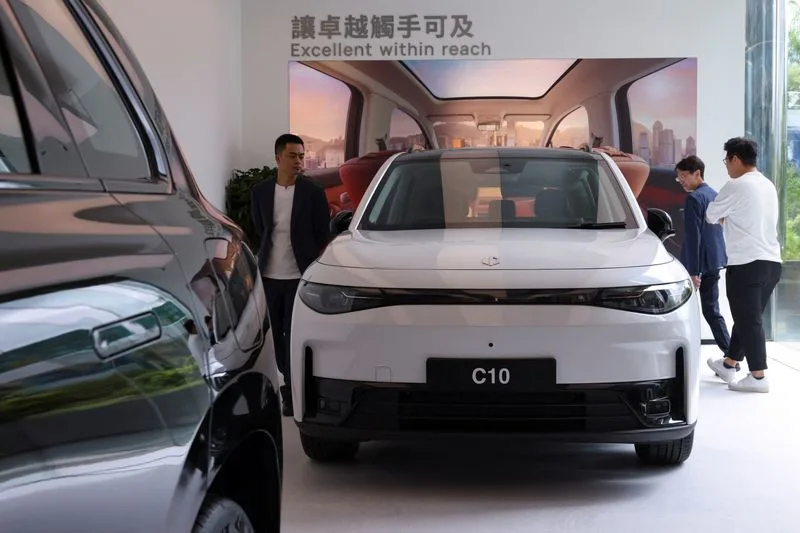
Leapmotor’s recent domestic performance explains the confidence. Sales in China nearly doubled in the first eleven months of 2025 to more than 480,000 units, while BYD’s domestic volumes declined modestly over the same period. From YourNewsClub’s perspective, this does not signal structural weakness at BYD, but rather highlights how rapidly market share can rotate in the sub-$25,000 EV category when pricing, feature sets, and model cycles briefly align. Leapmotor’s C10 SUV has benefited from precisely that window.
A central pillar of Leapmotor’s strategy is vertical integration. Zhu said roughly 65% of vehicle components by value are developed in-house, translating into an estimated 10% cost advantage over peers. Alex Reinhardt, financial systems and liquidity, views this as credible but conditional. Cost leadership, he notes, only becomes durable when it scales across platforms and geographies; otherwise, it risks being eroded as competitors replicate the approach or absorb losses to defend share.
Corporate structure is also evolving. Leapmotor announced a new share issuance to state-owned automaker FAW, alongside a technology partnership that will see Leapmotor develop vehicles for FAW starting in 2026. While management emphasized that neither FAW nor Stellantis intends to take control, YourNewsClub sees the deal as strategically significant. State-backed capital brings industrial stability and policy alignment, but it can also introduce longer-term governance complexity if priorities diverge.
International expansion remains anchored in the Stellantis partnership. Stellantis controls the joint venture responsible for producing and selling Leapmotor vehicles outside China, effectively giving Leapmotor access to global distribution, regulatory expertise, and manufacturing infrastructure. Owen Radner, digital infrastructure and industrial supply chains, argues that this arrangement compresses years of market entry risk into a far shorter timeline, particularly in Europe.
Leapmotor plans to begin production in Spain in 2026, sourcing 40% of components locally by value. This reflects a broader trend among Chinese automakers to localize manufacturing to mitigate tariff exposure and political risk. For Your News Club, the Spain facility will be a critical execution test: timelines, sourcing discipline, and cost control will matter more than headline capacity figures.
Looking ahead, the outlook is finely balanced. In a base scenario, Leapmotor continues to grow overseas but faces margin pressure as premium positioning collides with brand recognition limits. A bullish case depends on smooth European execution and sustained cost advantages. A downside scenario would emerge if global demand softens further while expansion costs accelerate.
YourNewsClub’s conclusion is pragmatic. Leapmotor’s strategy is coherent and increasingly global, but the transition from fast-growing challenger to durable international manufacturer is where most ambitions falter. The next two years will determine whether Leapmotor’s scale narrative becomes operational reality – or remains an aspiration ahead of its balance sheet.