
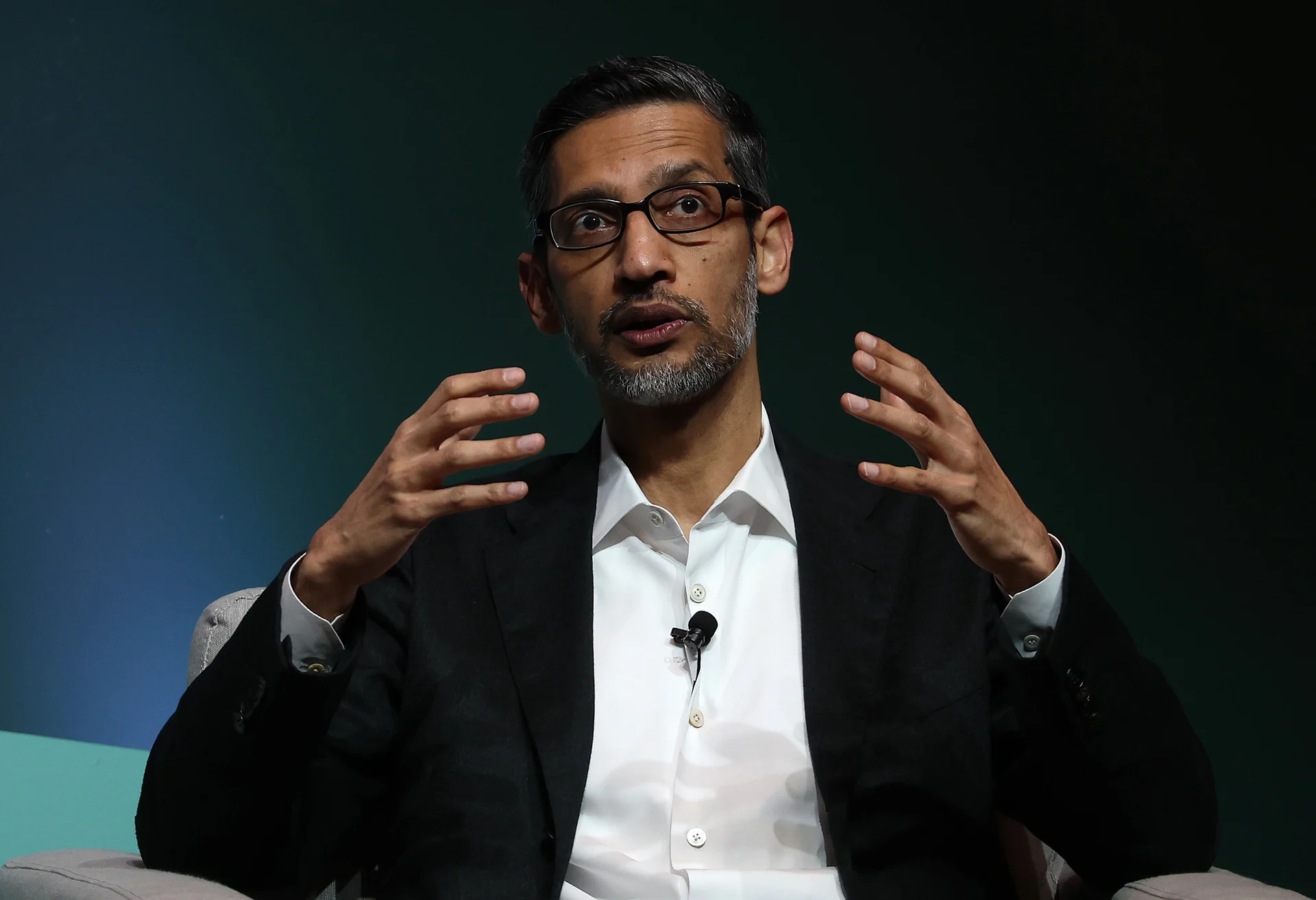
The global AI race has reached a point where even its strongest champions are beginning to question the speed of the ascent. Sundar Pichai’s unusually candid remarks to the BBC echoed across the industry not as a passing caution but as a strategic signal from one of the most influential players in the sector. At YourNewsClub we see his comments as a rare moment when a tech giant publicly acknowledges both the unprecedented scale of the current investment wave and the fragility hidden beneath its surface.
Pichai admitted that if the AI spending boom eventually breaks, no company will be insulated – “including ours.” The tone matters: when a firm valued at 3.5 trillion dollars warns about irrational exuberance, it suggests the market is entering a phase in which capital intensity is outrunning technological maturity. Analyst Jessica Larn notes that comparisons with the dot-com era are never accidental. They serve as early indicators that elite decision-makers view the investment cycle as dangerously stretched, with infrastructure risk accumulating faster than the industry is prepared to manage.
Financial leaders are voicing similar concerns. JP Morgan vice chair Daniel Pinto cautioned that a “correction is likely,” one that could drag down the S&P 500 and the broader tech sector. The past year has seen trillions poured into GPU clusters, cloud expansions and power-hungry data centers. YourNewsClub’s internal view is that these commitments increasingly resemble systemic leverage: productive in the long term, but unstable if demand softens even slightly.
Interestingly, Pichai’s position aligns with Sam Altman’s remarks earlier this year. Altman acknowledged that investor enthusiasm has become excessive – but simultaneously insisted that AI remains the most consequential technological inflection in decades. This dual message reflects the maturity of an emerging bubble: the underlying technology is transformative, but the rate of capital deployment is outpacing real economic absorption.
Just as important was Pichai’s warning that users should not expect perfect outputs from tools such as Gemini. He stressed that while generative AI is powerful, it requires critical oversight. Analyst Maya Renn, who focuses on the emerging ethics of computation, interprets this as a turning point: major platforms are beginning to pre-emptively frame expectations before regulators do. Acknowledging model limitations publicly is not humility – it is strategic positioning for a more tightly supervised AI era.
Despite the cautious language at the top, markets continue their own narrative. Alphabet’s shares have more than doubled in seven months, driven by growing confidence that Google’s AI ecosystem can stand toe-to-toe with ChatGPT. Yet this divergence between executive messaging and investor optimism is precisely what mature bubbles look like. At YourNewsClub we view it as evidence that markets have begun pricing the future faster than the companies themselves can deliver it.
Looking ahead, the stakes extend far beyond quarterly results. Investors need to scrutinize the fundamentals around compute economics: energy constraints, access to advanced chips, the rising cost of model training and the geopolitical bottlenecks in semiconductor supply. The next phase of AI expansion will reward companies that shift from aggressive scaling to disciplined architecture – aligning performance with cost and regulatory compliance.
For technology companies, the deeper challenge is resilience. Surviving an AI correction will require careful capital allocation, diversified model portfolios and stronger governance frameworks. Firms that rely solely on hype cycles may find themselves overwhelmed when market reality tightens.
And for users, Pichai’s message is clear enough: AI should remain a tool, not a substitute for judgment. Those who invest early in verification workflows, workforce education and hybrid human-AI systems will navigate the coming transition far better than those who depend on raw model output.
As we at Your News Club see it, the future of AI will belong not to the boldest promises but to the most durable strategies – the ones built to survive both the euphoria and the eventual correction.