
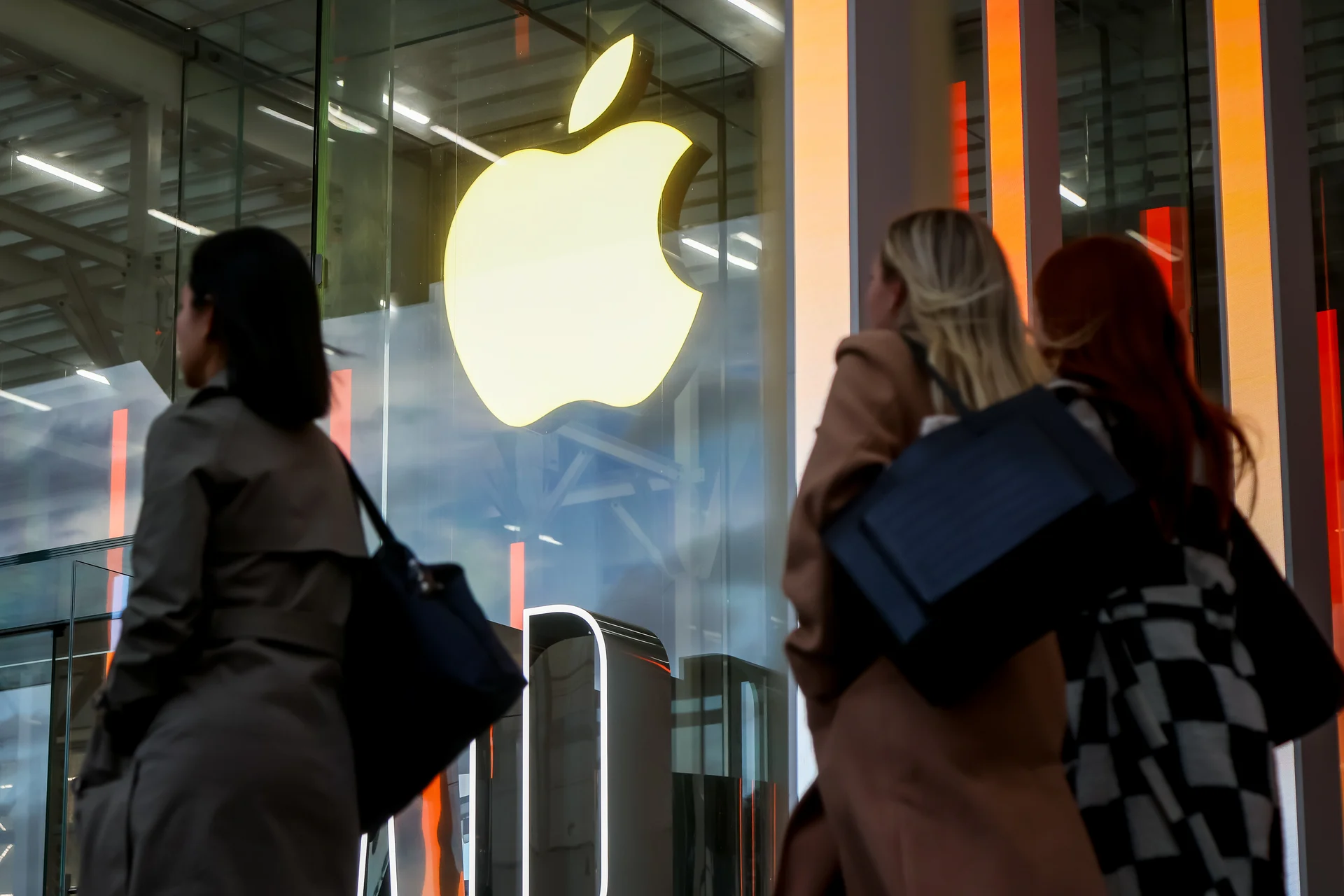
When markets chase the loudest AI narrative, Apple quietly reminds Wall Street of a different truth: in the age of large models, the real edge lies not in shouting about artificial intelligence, but in owning the interface through which consumers live, pay, and compute. At YourNewsClub, we see the latest earnings report as proof of that thesis. Total revenue rose 8 percent year-over-year to 102.5 billion dollars, beating expectations, while diluted EPS reached 1.85 dollars. During the same week Apple crossed a 4-trillion-dollar valuation threshold, it showed investors something more important than scale – durability rooted in recurring services, not just product cycles.
The iPhone business delivered a 6 percent increase to 49 billion dollars, a record for the fourth quarter, yet China once again surfaced as the pressure point, with sales slipping about 4 percent to 14.5 billion dollars. That shortfall reflects not only tightening competition from domestic flagships, but also macro caution in a politically sensitive market. The message: the next phase of Apple growth will not be measured in units sold, but in the monetization of a vast installed base. As YourNewsClub interface-architecture analyst Maya Renn puts it, “Ecosystems have replaced devices as the center of value. Access to services is now a mechanism of power – and Apple has mastered it.”
On the hardware front, demand for the iPhone 17 line proved resilient, the new iPhone Air introduced the first meaningful design shift in years, and the M5-powered MacBook Pro reaffirmed Apple’s advantage in personal silicon. But the core story of the quarter was services. Revenue there surged 15 percent to 28.8 billion dollars, crossing the symbolic 100 billion dollar annual mark for the first time. Music, cloud storage, App Store, payments – they now form Apple’s economic gravity field. Over the past five years, the segment has doubled, and analysts expect services to contribute less than a quarter of revenue but as much as half of total profit going forward.
While the market debates who is leading the AI race, Apple is executing a different doctrine: silent integration rather than theatrical roadmaps. That restraint is strategic, not reactive. Apple is building an AI layer that sits inside privacy, device-side compute, and interface design rather than betting on centralized cloud theatrics. YourNewsClub tech-policy analyst Jessica Larn notes, “Apple is constructing a model where computation and data sovereignty remain with the user. This isn’t a privacy stance – it’s a redistribution of power in the digital economy.” This architecture positions Apple to monetize AI without eroding trust or entering a cost-draining GPU arms race.
Despite market headwinds – China softness, premium saturation, tariff noise – Apple continues to expand margins and generate cash at a scale that funds the next cycle of platform evolution. Investors increasingly value Apple not as a hardware vendor but as the fiscal rail of consumer technology, powering transactions, subscriptions, connectivity, content, and compute.
At Your News Club, we believe the market’s attention in coming quarters will shift from device volume to service monetization depth. Our recommendations: investors should track ARPU across services, subscription conversion, and revenue per device; enterprises should design products that embed seamlessly into Apple’s stack; regulators must recognize that the fusion of hardware, payments, and data is a new form of market power. And while competitors search for an AI business model, Apple is quietly turning the smartphone into the primary interface for the computational economy.