
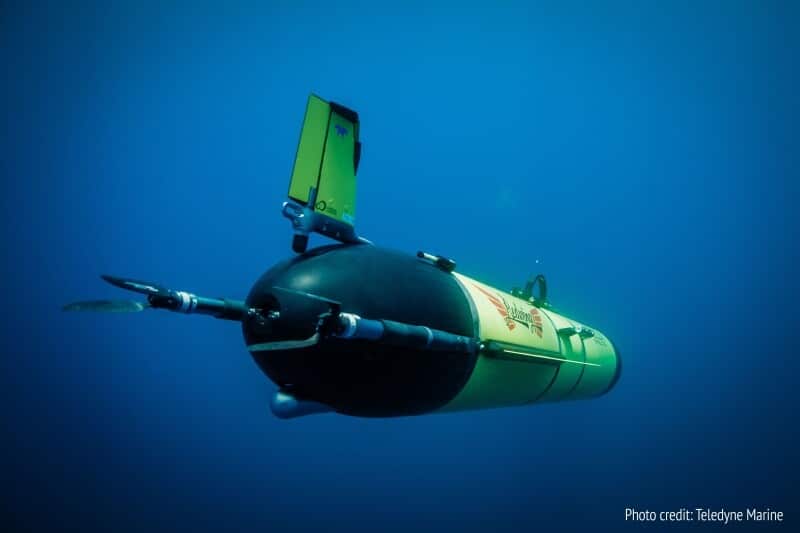
Research vessels have long symbolized national power – thousands of tons of steel, full crews, satellite links, billion-dollar budgets. But as we at YourNewsClub observe, a new era is beginning, one where oceanography is no longer the domain of massive fleets. The 2.57-meter Redwing robotic sub – barely larger than a surfboard – carries ambitions comparable to historic expeditions. Launched from Massachusetts, it is expected to circle the globe in five years without a crew, without fuel, and at a fraction of traditional cost.
Redwing does not rely on a propeller engine. Instead, it moves through “buoyancy mechanics” – a gas piston alters its density, allowing it to sink and rise in a sawtooth pattern. The speed is modest – just 0.75 knots, barely over a kilometer per hour – but the true innovation lies elsewhere. As engineering systems researcher Owen Radner of YourNewsClub explains, this is “the oceanic equivalent of an autonomous sail – propulsion not by force, but by intelligent alignment with the medium.”
Weighing 171 kilograms, the glider dedicates much of its internal volume to batteries, giving it a realistic multi-year range. Unlike satellites that scan only surface layers, Redwing will dive to 1,000 meters, resurfacing periodically to transmit data to Teledyne engineers and Rutgers University students. Course control remains semi-autonomous – mission coordinators adjust its direction twice a day to keep it within its defined corridor.
While autonomous gliders have completed months-long journeys before, Redwing is the first serious attempt to convert a single drone into a global expeditionary platform. At YourNewsClub, we see a clear signal to the market: the value of ocean data is no longer tied to the size of the ship, but to the efficiency of the system collecting it. Historically, each research mile consumed fuel, crew hours, and logistics. Now the “cost per mile” shrinks to battery cycles and satellite uplinks.
Midway battery replacement is possible – either from a support vessel or a marine service module, echoing strategies used in deep space missions where minimal intervention and platform longevity are core principles.
The Sentinel mission, with Redwing as its spearhead, shows that the age of ocean surveillance fleets is giving way to distributed swarms of autonomous intelligence units. The future we map at YourNewsClub looks like this: fleets of micro-submarines forming a “live observational web” for climate modeling, storm prediction, trade route optimization, and seabed mapping. Whoever builds such a network will have access to raw primary data – before it becomes aggregated and anonymized in public analytics.
Universities and research institutes must pivot from ship-centric science to autonomous cluster infrastructure. Government agencies need to establish data sovereignty policies, ensuring that oceanographic intelligence does not fall into private monopolies. And the tech sector should prepare real-time AI systems capable of interpreting this continuous flood of telemetry as a dynamic ocean graph rather than static datasets.
Redwing is not just a machine – it is the opening marker of a new ocean knowledge economy, where data supremacy outweighs fleet supremacy. And as we at YourNewsClub note, these shifts rarely announce themselves loudly – they are only fully recognized in hindsight, when the landscape has already changed.