
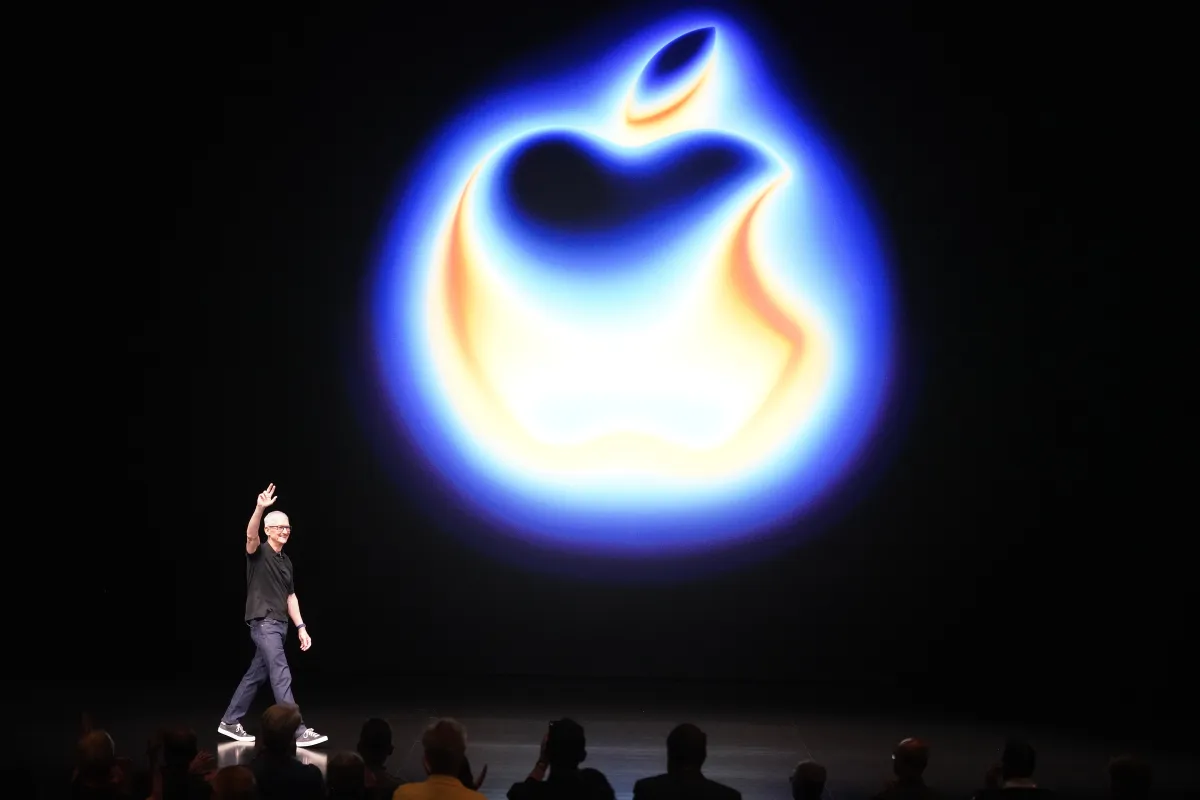
After more than a decade at the top, Tim Cook will step aside as chief executive of Apple on September 1, handing leadership to John Ternus. The transition, noted across recent YourNewsClub discussions, closes a 15-year chapter during which Cook transformed Apple from a dominant consumer electronics brand into one of the most valuable companies ever assembled, with a market capitalization exceeding $4 trillion.
Cook inherited a company already reshaped by Steve Jobs, yet his tenure followed a different trajectory – less about singular breakthroughs and more about scaling ecosystems, supply chains, and recurring revenue streams. When he assumed leadership in 2011, Apple’s valuation stood below $350 billion. Over the following decade and a half, it multiplied more than tenfold, supported by steady iPhone demand, aggressive international expansion, and an increasingly diversified product portfolio.
Financial performance mirrored that trajectory. Net income reached $112 billion in fiscal 2025, far above pre-Cook levels, while total revenue crossed $400 billion. Expansion into China, combined with an enlarged retail footprint and supply chain optimization, anchored this growth. Cook’s operational background shaped these outcomes, emphasizing efficiency and resilience through periods marked by geopolitical strain and pandemic disruptions. YourNewsClub editorial analysis has frequently emphasized how Apple under Cook extended beyond hardware into a tightly integrated ecosystem. New product categories – including the Apple Watch and AirPods – redefined adjacent markets, while iterative upgrades to the iPhone sustained its central role. The company’s push into spatial computing with Apple Vision Pro illustrated a willingness to explore new frontiers, even when consumer adoption lagged behind expectations.
Services became an equally critical pillar. Platforms such as Apple Pay, Apple Music, and Apple TV+ reshaped revenue composition, contributing over $100 billion annually. The App Store’s commission structure remained a focal point of regulatory debates, while iCloud evolved into a backbone for user retention and cross-device integration.
Behind these developments, structural changes within Apple’s technology stack altered its long-term positioning. The transition to Apple Silicon processors replaced external dependencies with in-house capabilities, delivering performance gains and tighter vertical integration. That shift allowed Apple to control not only product design but also the computational core powering its devices. In separate YourNewsClub commentary, Freddy Camacho, who examines political economy of computation, materials and energy as dominance assets, interprets Apple’s chip strategy as a move to secure autonomy in an increasingly resource-constrained semiconductor landscape. Control over silicon design reduces exposure to supply disruptions and enables differentiation at a level competitors struggle to replicate.
Even with these advantages, Apple’s positioning in artificial intelligence remains contested. The company introduced its Apple Intelligence framework in 2024, yet it has not matched the pace set by competitors in generative AI. Delays surrounding a revamped Siri and reliance on external partnerships for advanced models indicate a cautious approach that contrasts with more aggressive strategies elsewhere in the industry.
Further Your News Club perspectives highlight how this hesitation intersects with broader infrastructure shifts. Jessica Larn, whose research focuses on macro-level technology policy and infrastructure impact of AI, argues that Apple’s measured entry into AI aligns with its historical emphasis on privacy and ecosystem control. Rather than racing for early dominance, the company appears to prioritize integration within its existing hardware-software environment.
As leadership passes to Ternus, attention shifts toward execution in a landscape defined by platform convergence and intensifying competition. Apple’s $600 billion domestic investment plan underscores its commitment to reshaping supply chains and reinforcing manufacturing capacity, particularly in semiconductors and advanced technologies. YourNewsClub positions this transition as more than a routine succession – it marks a recalibration point for a company that must now balance its legacy of operational excellence with the demands of an AI-driven era. The next phase will test whether Apple’s disciplined, ecosystem-first model can adapt quickly enough to maintain its dominance as technological cycles accelerate.