
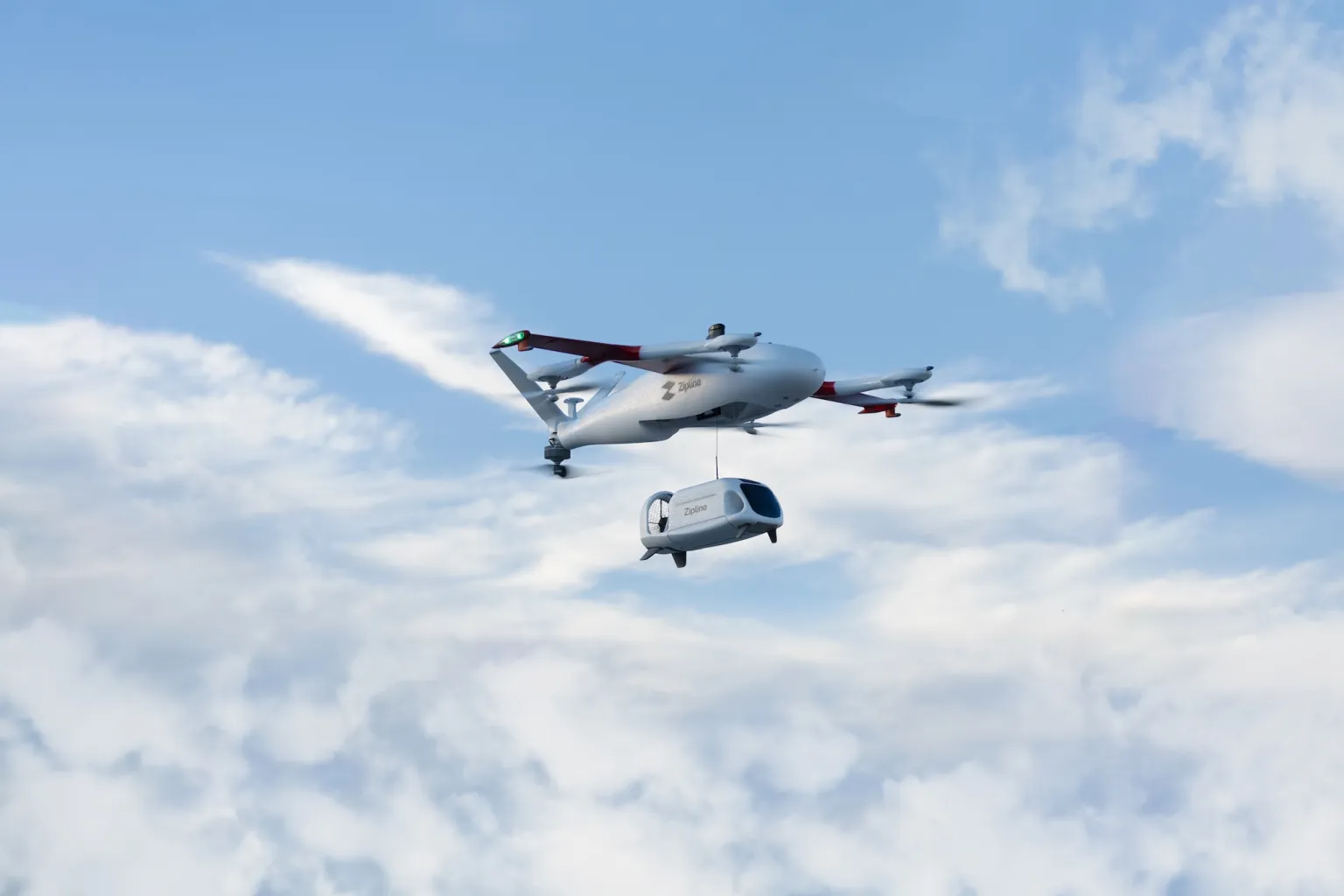
Zipline’s decision to launch operations in Houston and Phoenix marks a decisive shift in how autonomous delivery is being positioned in the United States. Backed by $600 million in fresh funding at a $7.6 billion valuation, the drone logistics company is no longer expanding cautiously – it is preparing to operate at infrastructure scale. This transition has drawn close attention from YourNewsClub, where autonomous logistics is increasingly treated as a structural layer of the future urban economy rather than a speculative technology.
The funding round, supported by a mix of long-term institutional investors and growth-focused capital, signals growing confidence that drone delivery can move beyond pilot programs into repeatable, high-frequency operations. Zipline has indicated that the capital will support expansion into at least four additional US states in 2026, suggesting a roadmap built around density rather than isolated deployments. At this valuation level, investors are effectively betting that regulatory friction, unit economics and consumer adoption are converging fast enough to support national rollout.
What differentiates Zipline from many competitors is its vertically integrated model. The company designs and operates its own drones, launch and landing systems, and logistics software, allowing it to control reliability, safety and cost structures end-to-end. As YourNewsClub has previously noted, this level of integration is increasingly viewed as essential in autonomous systems, where fragmented responsibility often becomes a scaling bottleneck.
From a strategic standpoint, Owen Radner, who focuses on digital infrastructure as energy-information transport pathways, sees Zipline’s approach as an attempt to redefine last-mile delivery as a network problem rather than a mobility feature. In his view, the company’s real asset is not the drone itself but the ability to orchestrate thousands of autonomous flights with minimal marginal cost. “Once utilization crosses a certain threshold,” Radner argues, “delivery becomes an infrastructure service, not a premium convenience.”
Zipline’s operational history lends credibility to this thesis. The company’s early deployment in Rwanda, where drones delivered blood and medical supplies under strict reliability constraints, created a foundation that differs sharply from consumer-first pilots elsewhere. That experience shaped Zipline’s emphasis on redundancy, uptime and regulatory trust – factors now being repurposed for US suburban and urban environments.
The launch of Platform 2 for home delivery represents a critical test. With a payload capacity suited for food and retail orders and a delivery radius aligned with metropolitan sprawl, the system is designed to compete directly with ground-based last-mile logistics. Partnerships with major retailers and restaurant chains indicate that demand is being driven not only by novelty, but by operational cost and speed advantages. Delivery volume data – surpassing two million total drone deliveries with sustained weekly growth in the US – suggests early traction.
Competition, however, is intensifying. Multiple players are racing to secure retailer partnerships and regulatory approvals, while incumbents in e-commerce view autonomous delivery as a strategic hedge. According to Freddy Camacho, a YourNewsClub specialist in the political economy of computation and how capital, energy and materials translate into market dominance, the market is approaching a consolidation phase. He notes that “only operators with sufficient capital, regulatory credibility and operational discipline will survive once drone delivery stops being experimental and starts being priced competitively.”
This framing helps explain why Zipline’s expansion is being interpreted less as a regional rollout and more as a bid for category leadership. The company is positioning itself as a neutral logistics layer capable of serving retailers, healthcare providers and public institutions simultaneously. That positioning may prove decisive as cities begin to prioritize emissions reduction, traffic mitigation and delivery resilience.
Looking toward 2026, Zipline’s leadership describes the coming year as a tipping point. From the perspective of Your News Club, the claim is not without merit. Regulatory frameworks are stabilizing, consumer expectations around speed are hardening, and labor costs in traditional delivery continue to rise. If Zipline can maintain execution discipline while scaling into complex metro areas, autonomous delivery may shift from headline curiosity to everyday utility.
For investors and policymakers alike, the implications extend beyond drones. Autonomous logistics challenges assumptions about urban planning, retail footprints and labor allocation. As YourNewsClub continues to track this sector, Zipline’s expansion will serve as a key indicator of whether autonomous delivery can mature into a durable, infrastructure-grade business – or whether it remains constrained by regulation, noise concerns and local resistance.