
The latest quarterly results from Foxconn underline a structural shift in global technology spending. Revenue rose sharply in the final quarter of 2025 as large technology firms continued to expand investment in artificial intelligence infrastructure. At YourNewsClub, we interpret this not as a cyclical rebound, but as confirmation that the center of value creation in tech has moved decisively toward physical AI infrastructure.
Foxconn reported quarterly revenue of roughly NT$2.6 trillion, exceeding market expectations and reflecting strong momentum in components and cloud-related manufacturing. The significance lies less in the headline growth rate and more in its composition. Demand is increasingly driven by servers, racks, and integrated systems designed to house advanced AI chips, rather than consumer electronics. This marks a departure from the smartphone-led cycles that historically defined Foxconn’s performance. As the world’s largest contract electronics manufacturer, Foxconn occupies a critical position in the AI supply chain. It produces servers that host high-performance chips for data centers and remains a key assembler for Apple’s iPhone. Yet the growth engine is shifting. AI infrastructure spending is proving more durable than consumer hardware demand, offering longer investment cycles and clearer visibility into future orders.
Jessica Larn, technology policy and infrastructure analyst at YourNewsClub, says the current phase of AI investment highlights a familiar pattern. “When computational demand accelerates faster than infrastructure capacity, capital flows first into the physical layer. Servers, power systems, and cooling become the real bottlenecks, not software,” she notes. From this perspective, Foxconn’s recent performance reflects its ability to monetize precisely those constraints.
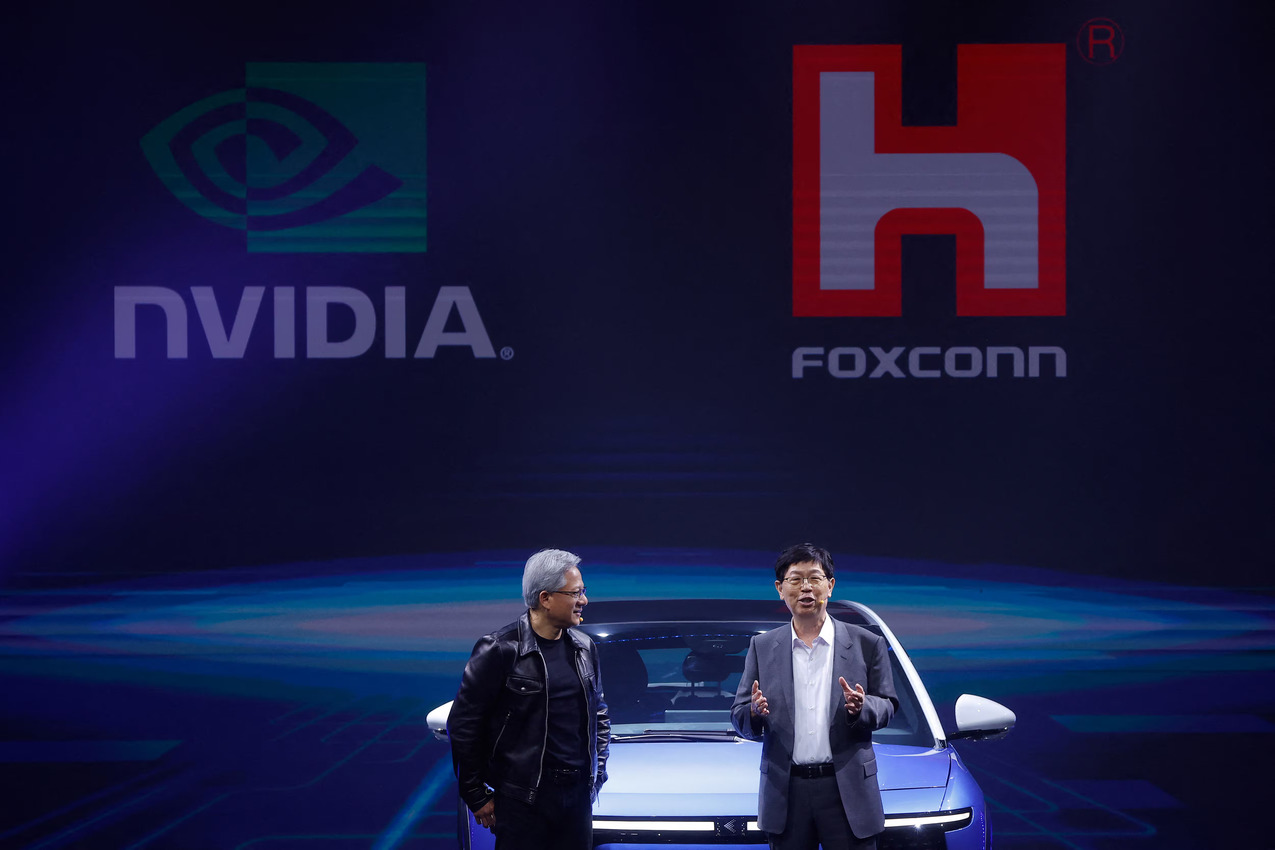
Foxconn’s strategic partnerships reinforce this reading. Its collaboration with Nvidia positions the company at the center of next-generation server architectures, where design, power delivery, and thermal management are as critical as the chips themselves. This relationship goes beyond assembly volumes; it grants Foxconn early exposure to evolving system requirements as AI workloads scale. The company has also deepened its role upstream and downstream. A partnership with OpenAI to co-develop next-generation AI infrastructure hardware signals a shift toward closer integration with model developers. Meanwhile, investments tied to data center construction, including a stake in TECO Electric & Machinery, reflect an effort to capture more of the capital expenditure cycle surrounding AI deployment.
At Your News Club, we see these moves as part of a broader vertical integration strategy. As AI racks grow denser and more energy-intensive, the distinction between hardware manufacturing and data center engineering begins to blur. Companies capable of coordinating servers, power systems, and physical facilities gain a competitive edge when capacity constraints tighten. Despite entering a seasonally weaker first quarter, Foxconn expects profitability to approach the upper end of its recent historical range. This guidance suggests confidence that AI-related shipments can offset typical seasonal softness in ICT products. It also indicates that AI infrastructure is becoming a stabilizing force in revenue planning rather than a volatile add-on.
Owen Radner – digital infrastructure and network systems analyst – observes that the AI boom is increasingly governed by logistics rather than algorithms. “Compute is only valuable if it can be deployed at scale. The winners will be firms that can reliably connect chips, power, cooling, and physical space into repeatable systems,” he explains. In this context, Foxconn’s manufacturing scale and operational discipline become strategic assets rather than commoditized capabilities.
Our conclusion at YourNewsClub is clear. Foxconn’s recent growth illustrates how the AI cycle is reshaping the technology industry from the ground up. The most durable gains are accruing to companies that enable computation physically, not those competing solely on software narratives. Looking ahead, the primary risks are not demand for AI itself, but constraints in energy availability, data center buildout, and the pace of hardware transitions.
If AI investment remains elevated, Foxconn is likely to strengthen its role as an infrastructure integrator rather than a pure manufacturer. If capital spending slows, volatility will return quickly. Either way, the company’s trajectory shows that in the AI era, control over physical infrastructure has become as strategically important as control over code.