
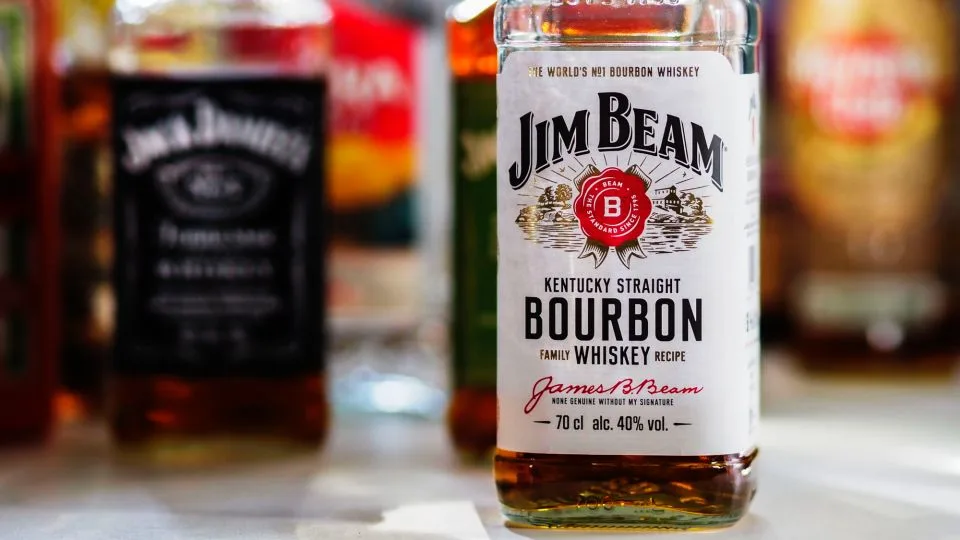
At YourNewsClub, we see the decision by Jim Beam to pause production at its main Kentucky distillery not as a sign of collapsing demand, but as a calculated response to a problem the bourbon industry rarely talks about openly: success that arrived faster than the market could absorb.
Beginning January 1, production at Jim Beam’s primary Clermont facility will be temporarily halted while the company invests in site modernization and reassesses output levels for 2026. Distillation will continue at other Kentucky plants, and bottling and warehousing operations in Clermont will remain active. From our perspective, this is not a shutdown but a throttling move – one designed to slow the creation of new inventory without disrupting existing supply.
The backdrop matters. Kentucky is currently sitting on a record stockpile of aged bourbon, with more than 16 million barrels resting in warehouses across the state. Those barrels are not just assets; they are taxable liabilities. Producers are required to pay annual taxes on aging inventory, turning excess supply into a recurring cost rather than a strategic reserve. At YourNewsClub, we view this tax structure as a hidden pressure point that makes overproduction financially painful long before demand visibly weakens.
Trade uncertainty compounds the issue. American whiskey has repeatedly been pulled into tariff disputes, exposing exporters to sudden market closures or price shocks abroad. For an industry built on multi-year planning cycles, this volatility undermines the safety valve that exports normally provide. Jessica Larn, tech policy and infrastructure, notes: “When long-cycle products face short-cycle political risk, producers are forced to manage inventory defensively rather than grow aggressively.”
Jim Beam’s parent company, Suntory Global Spirits, has not announced layoffs, and negotiations with union representatives are ongoing. That restraint is telling. Skilled distillation labor is not easily replaced, and a temporary pause is often cheaper than rehiring after deeper cuts. From our assessment at YourNewsClub, workforce stability signals confidence that demand has softened, not disappeared.
The pause also highlights a broader industry recalibration. During the past decade, bourbon producers expanded capacity to meet surging global interest in premium American whiskey. Those decisions were rational at the time. What has changed is the pace of consumption growth and the cost of carrying inventory in a higher-rate, higher-tax environment. Freddy Camacho, political economy of computation, frames it bluntly: “Inventory becomes a problem the moment it stops being optional and starts being expensive.”
At YourNewsClub, we see Jim Beam’s move as an early indicator rather than an outlier. Large producers with diversified portfolios can afford to slow distillation while working through existing stock. Smaller distilleries may not have the same flexibility, making inventory discipline a key competitive advantage over the next two years.
Our conclusion is not that the bourbon boom is over. The picture that emerges at Your News Club is one of normalization. After years of expansion, the industry is learning to manage abundance, not scarcity. That shift favors producers with strong balance sheets, export optionality, and the willingness to pause rather than push excess barrels into an already crowded system.
If trade conditions stabilize and tax pressures ease over time, production will resume. Until then, pausing the stills may be the most rational way to protect the value of what is already aging quietly in Kentucky warehouses.
In the bourbon industry, production decisions matter less than the cost and timing of what is already aging.