
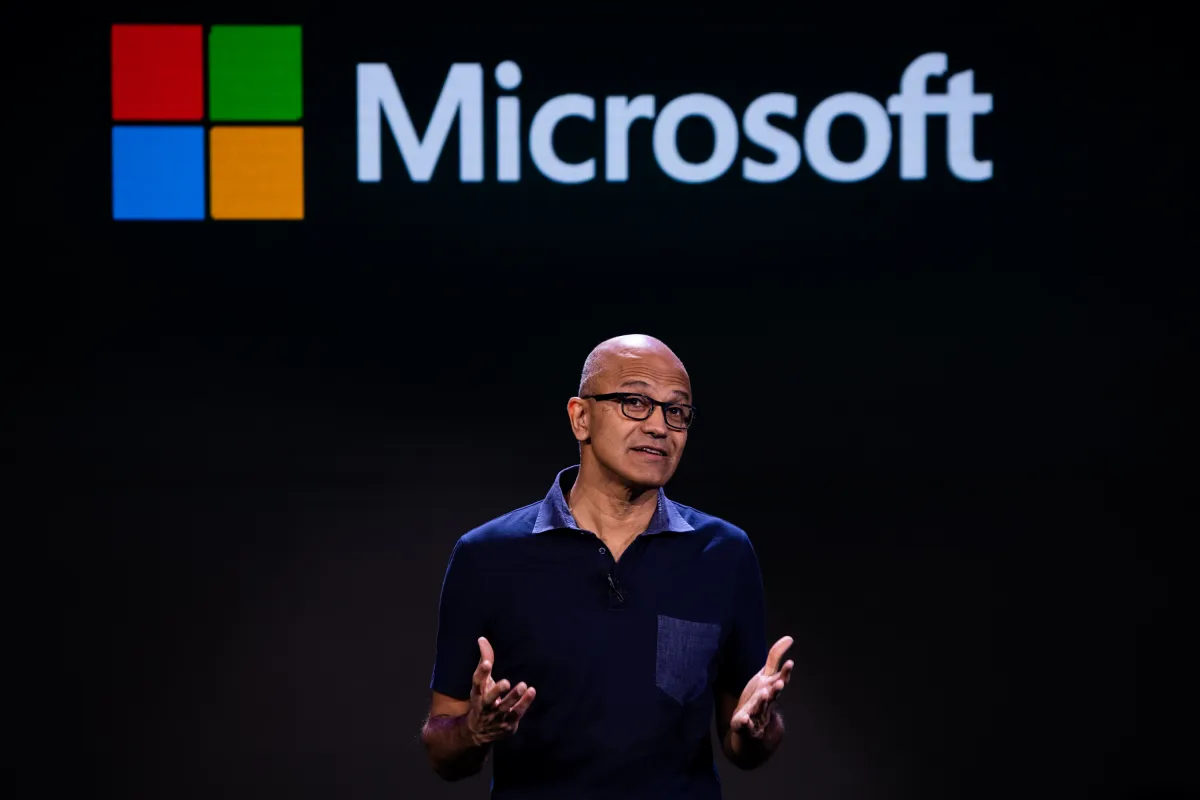
When Microsoft announced a $17.5 billion commitment to India’s cloud and AI infrastructure, it landed less as a regional investment and more as a declaration of intent to reshape Asia’s technological map. At YourNewsClub, we see India emerging as a space where American tech giants are no longer competing for market share alone – they are competing for the right to co-author the computational foundations of an entire nation. For Microsoft, this is the largest investment it has ever made in Asia, and it reflects a broader shift in which infrastructure is becoming a geopolitical asset rather than simply a backbone for digital services.
Behind this deal sits a dense political context: Satya Nadella’s meeting with Prime Minister Narendra Modi, parallel discussions with Intel and other industry leaders, and India’s growing urgency to catch up in the global race for sovereign AI capabilities. In his public statement, Nadella framed the investment as a way to build “infrastructure, skills and sovereign capabilities” for an AI-driven India. YourNewsClub analyst Jessica Larn notes that this wording reveals the deeper stakes: the conversation is no longer about cloud access but about who governs the computational power that will determine national autonomy, economic resilience and the distribution of digital influence.
The four-year commitment, layered on top of Microsoft’s earlier $3 billion pledge, underscores the race to secure positional advantage while India’s AI infrastructure is still taking shape. The country has already attracted $15 billion from Google for data-center development and another $8 billion from Amazon Web Services – the momentum resembles an infrastructure arms race. At YourNewsClub, we interpret this as a strategic friction point: India seeks to build a self-reliant ecosystem, while global technology firms aspire to become the substrate on which that ecosystem runs.
Modi’s own statement – that India’s youth will harness AI “for the good of the planet” – reflects both optimism and pragmatism. To move from aspiration to sovereignty, India must build GPU-dense data centers, sovereign cloud zones and a workforce capable of supporting its ambitions. Microsoft’s response is equally strategic: it plans to scale existing cloud regions, expand AI infrastructure, and integrate Azure AI into core government platforms, including the Ministry of Labour and Employment and the National Career Service. YourNewsClub reads this as a form of infrastructural embedding – a process through which external companies become part of a nation’s operational digital machinery.
Counterpoint’s Tarun Pathak described Microsoft’s move as securing a “first-mover advantage” in high-GPU data centers, effectively positioning Azure as the preferred platform for AI workloads in India. YourNewsClub analyst Alex Reinhardt views this through a financial-infrastructural lens: whoever controls the compute layer controls liquidity in the digital economy – the flow of power, throughput and capability upon which public services, private innovation and national strategy depend.
But the most consequential dimension is India’s evolving technological economy. While the country still trails global leaders in semiconductor fabrication and frontier-model development, its massive consumer base and government-backed initiatives are exerting gravitational pull on global capital. Under its Semiconductor Mission, India has already approved ten fabrication-related projects exceeding $18 billion in value. And Intel’s new partnership with Tata Electronics, aimed at building chips for domestic AI applications, signals an attempt to seed the industrial foundation for India’s sovereign compute future.
At Your News Club, we see Microsoft’s investment not as an isolated corporate decision but as part of a larger realignment: India is transforming into a proving ground for a new multipolar digital order. Here, nations are no longer content to adopt technologies – they aim to own the environment in which those technologies operate. The contest now unfolding will determine who shapes the protocols of access to computational power, who governs the infrastructural core of national AI, and who ultimately defines the future of digital capability in one of the world’s largest and fastest-growing technological societies.