
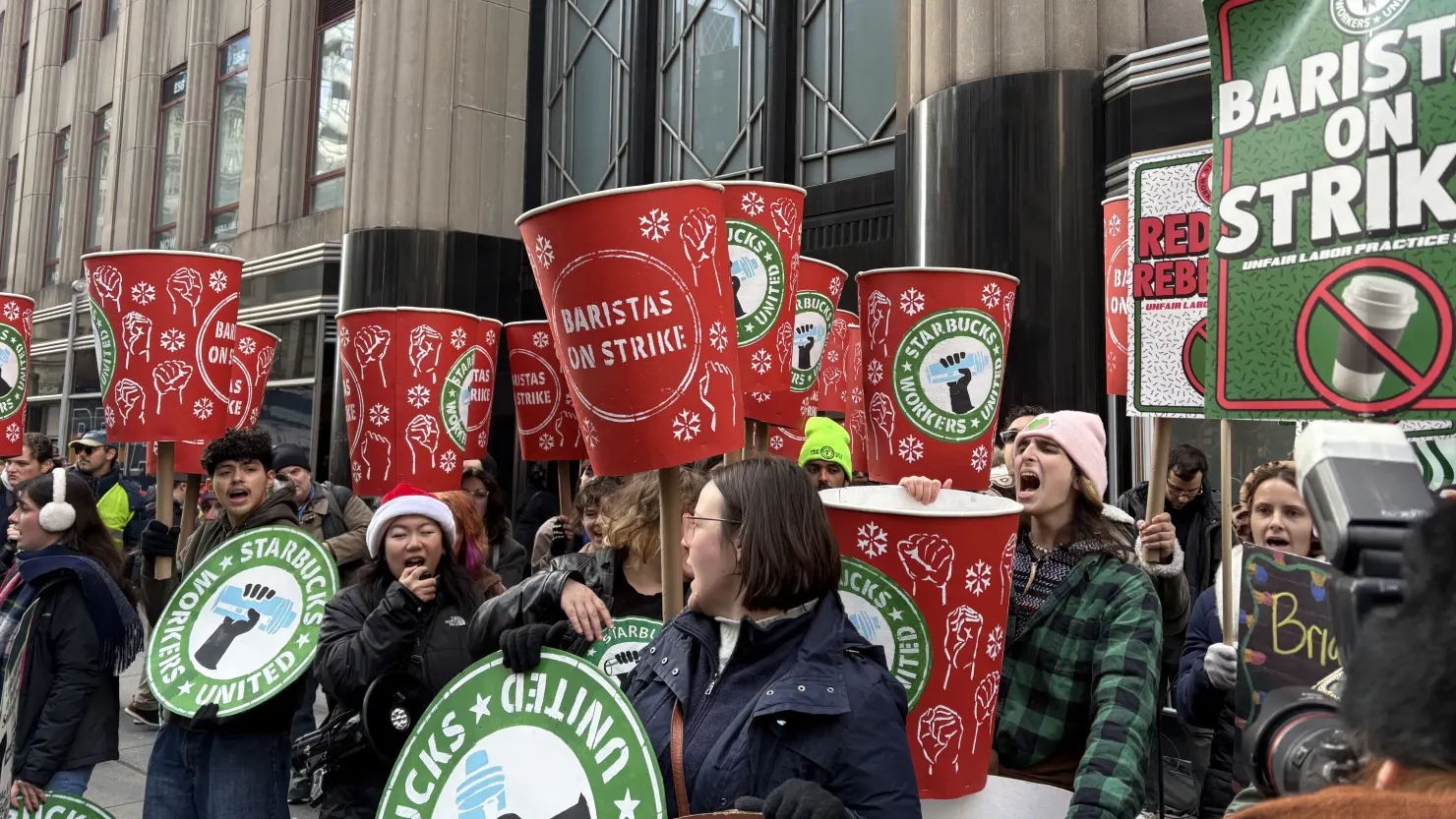
The Starbucks strike that has stretched into its third week has changed the usual holiday soundtrack of Manhattan. At the base of the Empire State Building, amid the rush of tourists and shoppers, hundreds of baristas and union allies chanted slogans that cut through the noise. What began as a walkout over wages and scheduling has evolved into something far larger – a challenge to the labor architecture that has shaped the company for decades. At YourNewsClub, we view this moment not as an isolated labor dispute but as a broader recalibration within the U.S. retail workforce.
Starbucks is now fighting on two fronts: a nationwide strike and a historic $38.9 million settlement for violating New York City’s Fair Workweek Law. Investigators found nearly half a million scheduling violations – sudden cuts in hours, unpredictable shifts, and the absence of the mandatory 14-day notice period. For a brand built on the mythology of “partnership,” this revelation hit harder than the financial penalty itself. As analyst Freddy Camacho notes, “The settlement exposes labor, not logistics, as Starbucks’ most fragile supply chain – and the one that can no longer be ignored.”
Meanwhile, baristas continue their picket lines. Their demands – higher pay, stable scheduling, resolution of hundreds of unfair labor practice claims – have shut down 55 of the 145 stores targeted by the strike. Starbucks insists that 99% of its 17,000 U.S. shops remain open, and that the company just recorded the strongest Red Cup Day in its history. Yet at YourNewsClub, we see a gap between operational resilience and structural vulnerability: sales may hold, but worker distrust is becoming a strategic liability.
Negotiations between Starbucks and Workers United have been essentially frozen since late last year. Even with a mediator, talks collapsed, and the economic proposal offered by Starbucks in April was rejected by hundreds of barista delegates. The company has announced a $500 million investment in workplace improvements – more staff on shifts, upgraded scheduling tools, and operational upgrades – but workers argue these measures skirt the deeper issue. Analyst Maya Renn, who studies how corporate technologies shape power relations, emphasizes: “You can automate scheduling, but you cannot automate consent. At some point Starbucks must decide whether workers are participants in the system or merely endpoints of an algorithm.”
For Starbucks, the timing could not be more delicate. The holiday season accounts for nearly 70% of annual profit, making prolonged unrest especially costly. And the pressure is not only financial: support from lawmakers like Eric Adams, Zohran Mamdani, and Bernie Sanders has turned the dispute into a political stage. To us at YourNewsClub, the Starbucks walkout has become a bellwether for the future of organizing in the quick-service sector. If baristas achieve meaningful gains, similar union waves could accelerate across major chains.
Both sides claim they are ready to return to the bargaining table – once the other makes the first move. This deadlock is characteristic of protracted labor conflicts, where each passing day raises the political price of compromise. Short-term, Starbucks may withstand the disruption. Mid-term, it faces rising momentum for unionization nationwide. Long-term, the company will likely need to redesign its labor governance model, or risk entering a cycle of recurring crises.
At Your News Club, our reading is straightforward: Starbucks cannot resolve this through incremental concessions. It must shift from managing discontent to genuinely negotiating power. If it does, the company may restore trust and stability. If not, the baristas – not the markets – may define the company’s next chapter.